Singing in the Wilderness: reconstructing Dune pt.3
I thought I was done, but one more thing…
The biggest of all Dune’s sinews is probably scarcity: the whole book is a paean to the power of lack. Water is scarce on Arrakis, friends and manpower are scarce for the Atreides, Spice and transport are scarce in the universe. The importance of maintaining that scarcity is why Dune doesn’t mash up all that well with many other fantasies – there are ways to do it, but they’re not easy or satisfying.

There really should be a stage play. Although I’m not sure a rock opera is the right way to go.
In contrast, Star Wars is built on abundance and therefore threatened only by willful, perverse malice. The galaxy abounds in habitable worlds, a smuggler or a fugitive Jedi can always run to one that lies forgotten, off the main trade routes.
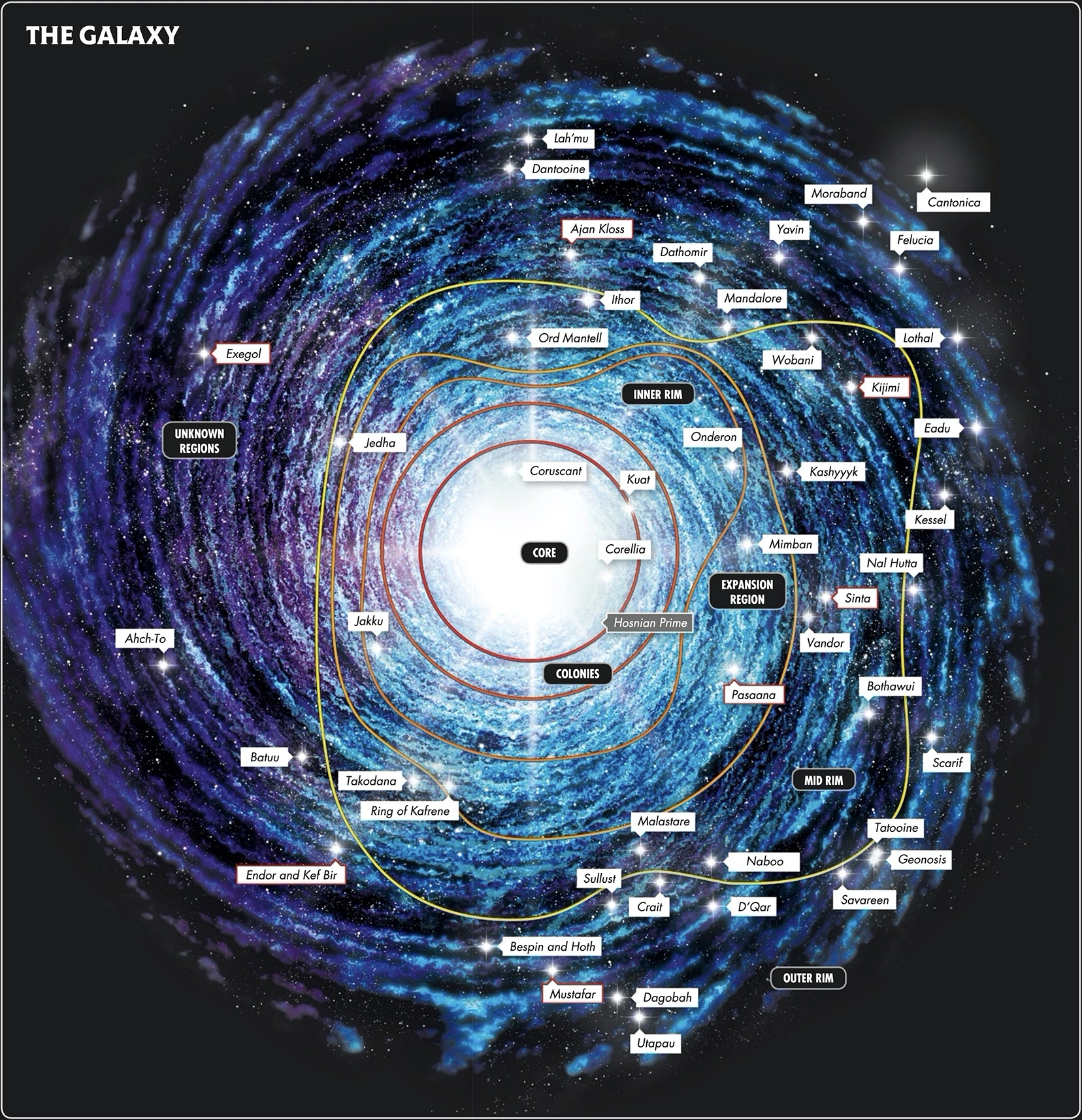
A guerrilla rebellion can keep regrouping and recruiting endlessly, beyond the gaze of power. It also has abundant time – old religions lie buried for centuries while the worlds move on around them, fructifying in the fertile loam of resentment and once-and-future lost causes, while Dune, despite its 10,000 years of stasis, is right on the edge of collapse when we arrive.
You could force Star Wars and Dune together – if Star Wars’s galaxy, reachable by jump drive, is all shallow then the Guild’s deep reach is intergalactic or interdimensional. The connections the Guild makes are completely arbitrary and strictly limited – they could be across time or genre as well as space (and it might be fun to add a little time travel to Star Wars’s relentlessly expanding universe and to hack Dune’s prophecies and portents – a Heighliner could shuttle between the Coruscant of Darth Vader and Alderaan of a thousand years before without collapsing the Star Wars universe, as long as the Guild kept a choke-hold on who and what could take that path). But it wouldn’t add anything very dramatically interesting to the Dune side, I think, because the drama of Dune depends on restrictions on action. Work with the Emperor or become a pauper, fugitive, renegade. Work with the Guild or be exiled. Like Sartre’s No Exit and Greenaway’s The Cook, The Thief, it’s important that Dune’s players are locked together and that there is no useful outside to Dune’s political chambers.
Dune’s scarcity also breeds secrecy – the Schools jealously guard their special powers; the competitions and vendettas over resources have a desperate edge because they’re all zero-sum: there is this much and no more. So I think if you want a bit of Dune flavour but not the whole Duniverse, it might work best in a wainscoting fantasy setting – something like Harry Potter or Narnia, where the Guild and Bene Gesserit can be secret societies hiding in the plain sight of Postwar Britain, or whatever other claustrophobic setting you prefer.
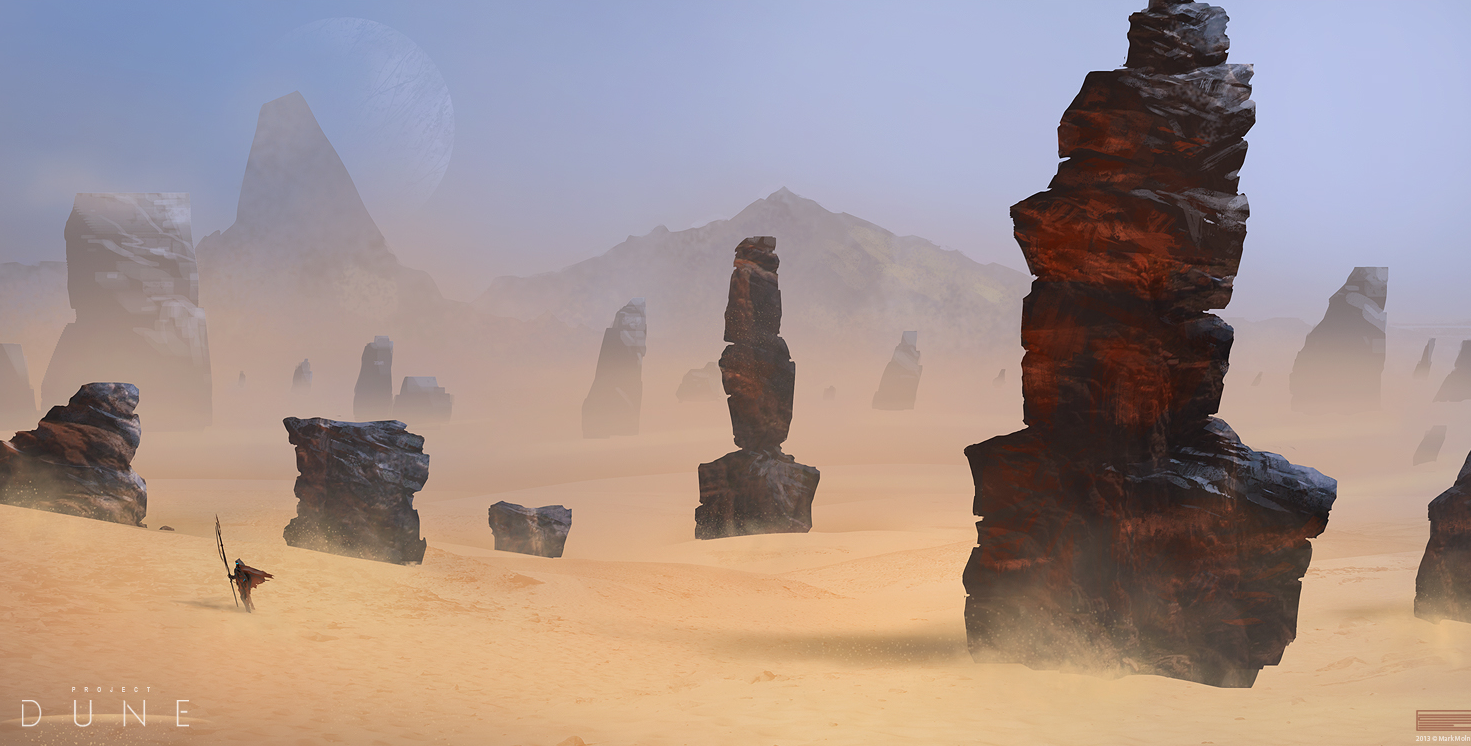
for Tim Powers fans, Mark Molnar has already provided the perfect poster for mashing Dune up with Declare. Disquietingly mobile rocks might be the Sandworms of the esoteric djinn Cold War.
Am I just saying “try adding the Bene Gesserit to your Unknown Armies game”? Honestly that’s not a bad idea, but instead it occurs to me that Dune might be a great third ingredient for the Traveller-Narcos game I proposed a while ago.
In this setting, the Spice is illegal and desired nearly everywhere in the galaxy – partly for the reasons cocaine is illegal (addictive, socially disruptive, too much fun), but even more so because it’s actively dangerous to the rules that States operate by: it can offer prophetic visions of the future that collapse the stock market, it extends lifespans to the point where life insurance no longer makes sense, and it just might let you migrate invisibly to someplace the State cannot catch and tax you. Spice smuggling is in the slippery hands of giant, vicious cartels and is such a big business that it inevitably destabilizes any individual planetary government it touches. Most ordinary criminals won’t touch it for fear of the cartels’ weirdo assassins and trackers – which include some cult of mind-reading women and a shadowy “guild,” that isn’t in any one cartel, but everyone seems to be afraid of. None of the Trade is carried on computer media – too traceable – but instead rests encoded in the heads of the cartels’ Mentats – and the various cadres of undercover cop Mentats, the product of training programs by governments that have invested a Spice-price in trying to stuff the genie back in the snuffbox. You play a smuggler cell that might unwittingly be a deep-cover government operation, trying to pay off your crippling ship mortgage by doing covert missions for a mysterious handler, which keep pulling you closer and closer into the secret heart of spice production – some backwater desert planet infested by murderous vermin.
When you finally make contact with some actual Spice producers, it turns out they’re nothing like the zero-sum desperadoes in transport and distribution. In fact, they seem completely uninterested in making any money off the stuff – long-term, high-intensity contact with Spice has opened their minds to the point where they no longer experience scarcity at all. They can offer you direct transport, ship-free, to the multiverse – a world of perfect freedom in which all the power structures of your own world would collapse, for lack of handles on the populace.

On a throne of an apartment
With a wide open
Mouth full of teeth
Waiting for the arrival of death
Because far from the
Flagged fences
Which separate yards
On the calm peak
Of my eyes I see
The soft sound shade
Of a flying saucer
So the question is, do you go with them on an adventure where you don’t need money, or do you take the trappings of scarcity’s upper crust?
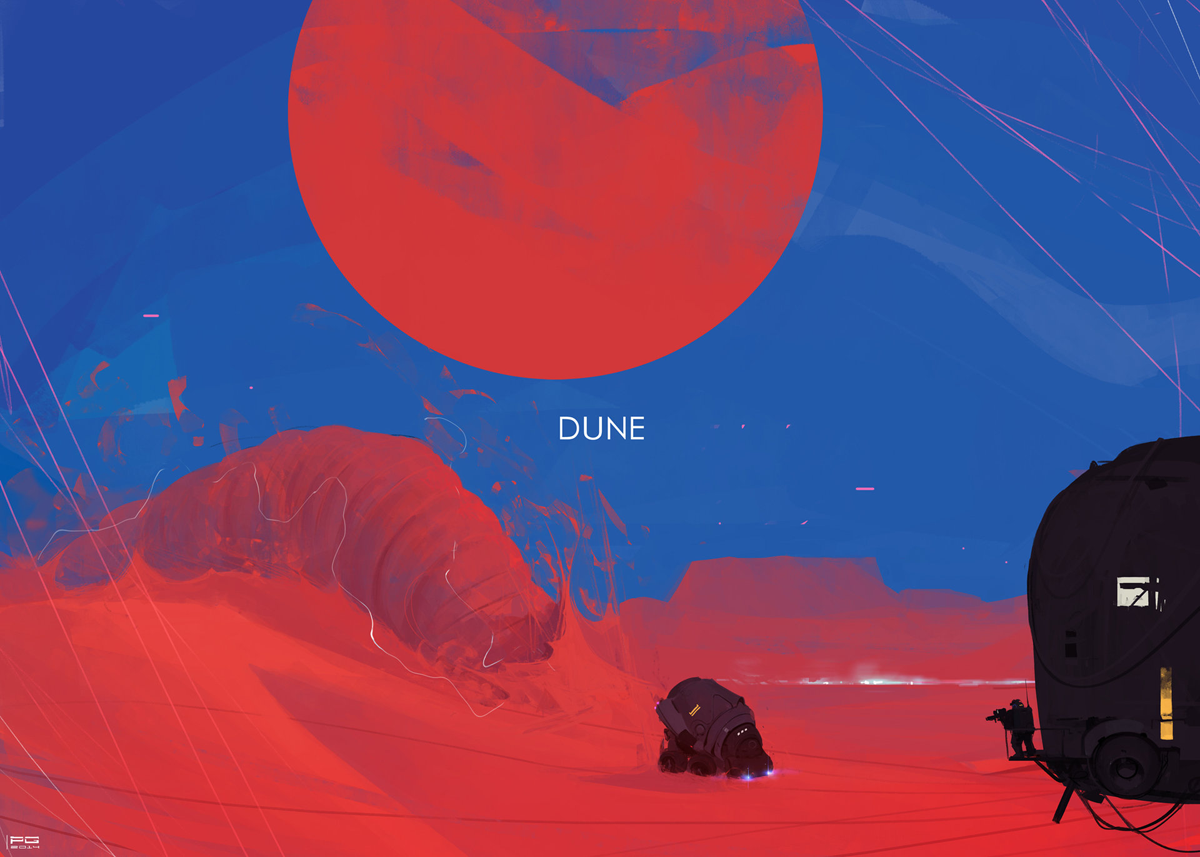
these guys insist all you need for this adventure is a book of verse, a jug of wine, a loaf of bread… and enough hyperdrugs to swim in. Also they have a busted old Airstream caravan and some ugly macrame blankets covered in cat hair.
Art by Mikhail Borulko.
ˇ
ˇ
ˇ
(Because the funny thing about Herbert’s magic mushroom universe is, it’s so damn Capitalist. Right in the middle of the postwar freak-out, surrounded by the hippie promise that all this Square materialist fear was just a crisis of the birth of the New Age, there’s Herbert the anti-hippie in goddamn Oregon tripping on dreams of endless and inevitable slavery and doomed Mohammeds and tragic millenia, cranking that old Wheel of deceit and violence around One More Time.)
“And do you think that unto such as you
A maggot-minded, starved, fanatic crew
God gave a secret, and denied it me?
Well, well—what matters it? Believe that, too!”
― Omar The Tent-seller, Quatrains
Machines As The Measure Of Men: reconstructing Dune pt. 2
(part 1 discussed Dune’s factions and drew a distinction between those parts of a setting that make it work (the sinews) and those parts that are pure flavour, that could be reskinned without risking the setting falling apart or becoming incoherent (the fat, maybe). I recommend reading it before this part.)
2: Technologies
Villeneuve’s best work in Dune is in getting machines to tell the story. Every machine has the personality of the people who made it. Each one reinforces its maker’s power position in the narrative.
First, all the stuff that comes from off-world is a study in scale contrasts. The brutalist carryall from Lynch’s Dune is now the basic spaceship form – they still hang in the sky like bricks don’t but under Villeneuve’s carefully-angled cinematography they’re beefed up the point where you wonder why the Atreides ever disembark from them – they could just flatten Arrakeen and replace it.
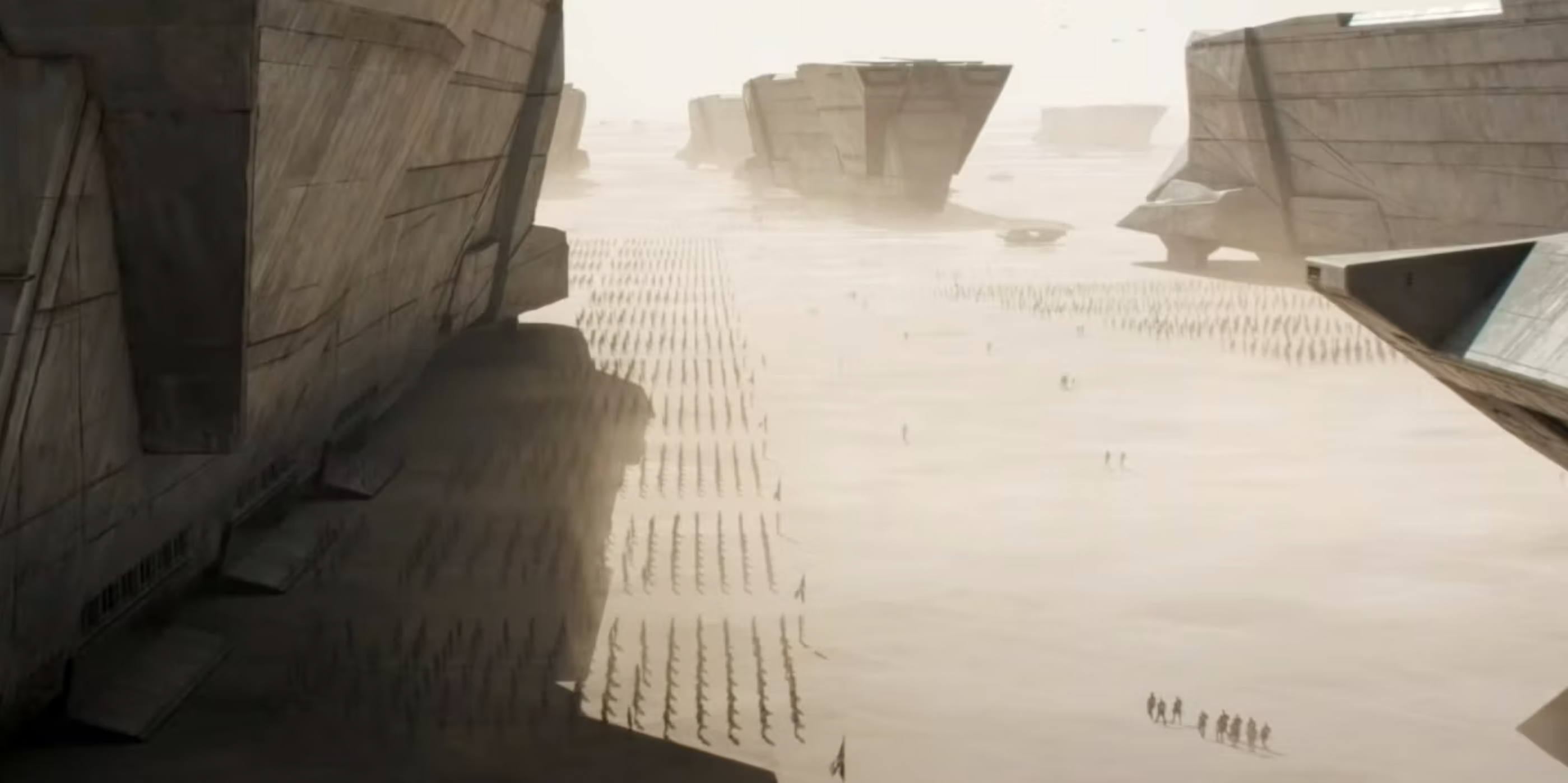
As for making the factions as distinctive as possible, Villeneuve’s approach is (sometimes) radical. The Harkonnens are rather unimpressive on Arrakis – black-clad, pallid, fat goths – until you realise their home world is literally black and white or, rather, infra red, like their thinking.

And while the Atreides and Harkonnens fly brick dumpsters, the Emperor flits in on Anish Kapoor’s Cloud Gate – an effete, feckless look for an ineffective figurehead.
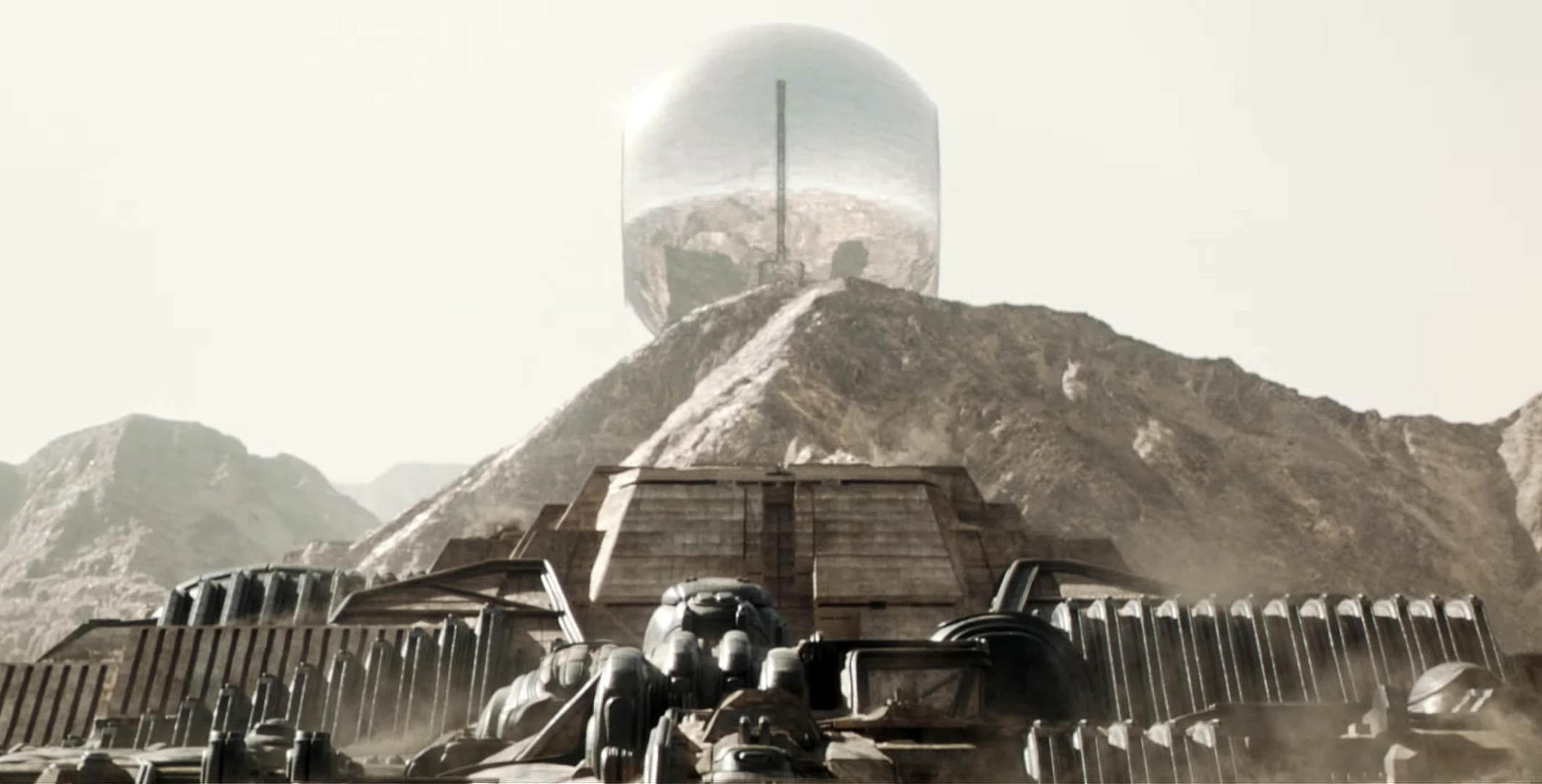
But the masterpiece of the whole film is the Harkonnens’ spice harvester. Villeneuve sets us up for meh with the basic harvester in part 1. It’s big but… flat, like NASA’s Crawler Transporter. It’s what you’d expect a harvester to be – a supporting player, not poised to steal the show from the charismatic lead.

But that, you see, is a jank old busted harvester, what the Harkonnens leave behind for the Atreides to complain about. The real Harkonnen spice harvesters, when they’re finally properly unveiled in part 2, are a symphony of signs: colossal, overweening, top-heavy, parasitic – like the spider-head in John Carpenter’s The Thing.


And of course it’s all ironic: the bigger they are, the harder they fall to a bunch of Fremen who pop up out of the sand exactly like the anti-tank miners in Stalingrad.

Because one of Herbert’s big sinewy ideas is: comfort makes you weak. Getting a machine to do your work is inviting disaster, because someone who is tougher (because he doesn’t have a machine) will take everything from you. Or, as Mad Magazine put it in 1960:

BTW for a really good discussion of technology, power, and their attendant colonialist superiority complexes, check out Michael Adas’s book, which supplies this post’s title. I think Herbert was suspicious of technosaviour arguments, as Adas notes the British and French were, just in time for Vietnam. Whether his Fremen were secretly based off the Viet Cong, Iranian Revolutionaries or any other IRL group is beyond the scope of this blogpost.
Anyway. Herbert’s second sinew is less often remarked: being tougher doesn’t make you politically smarter. The Fremen and Sardaukar warriors are technologies, too – conditioned by neglect to be “tough, strong, ferocious men,” they are also therefore vulnerable to the old mind tricks: “play on the certain knowledge of their superiority, the mystique of secret covenant, the esprit of shared suffering.” Get that right and they’ll be strongly, ferociously, fanatically loyal and obedient. Although once you’ve set them in motion, they’re also liable to be as hard to stop or redirect as a Harkonnen spice harvester. Once they’ve got an idea in their heads, it’s almost impossible to dislodge it with a new one.
Cue another Dune sinew: the Superior Man is flexible. He makes use of tools but is aware of how those tools will try to shape him. He refuses to be shaped except by his own will.
(Does this sound like Mein Kampf? Noooo, it’s probably just Nietzsche.)
The most thoroughly iterated representation of this idea is the Holtzman shield generator.
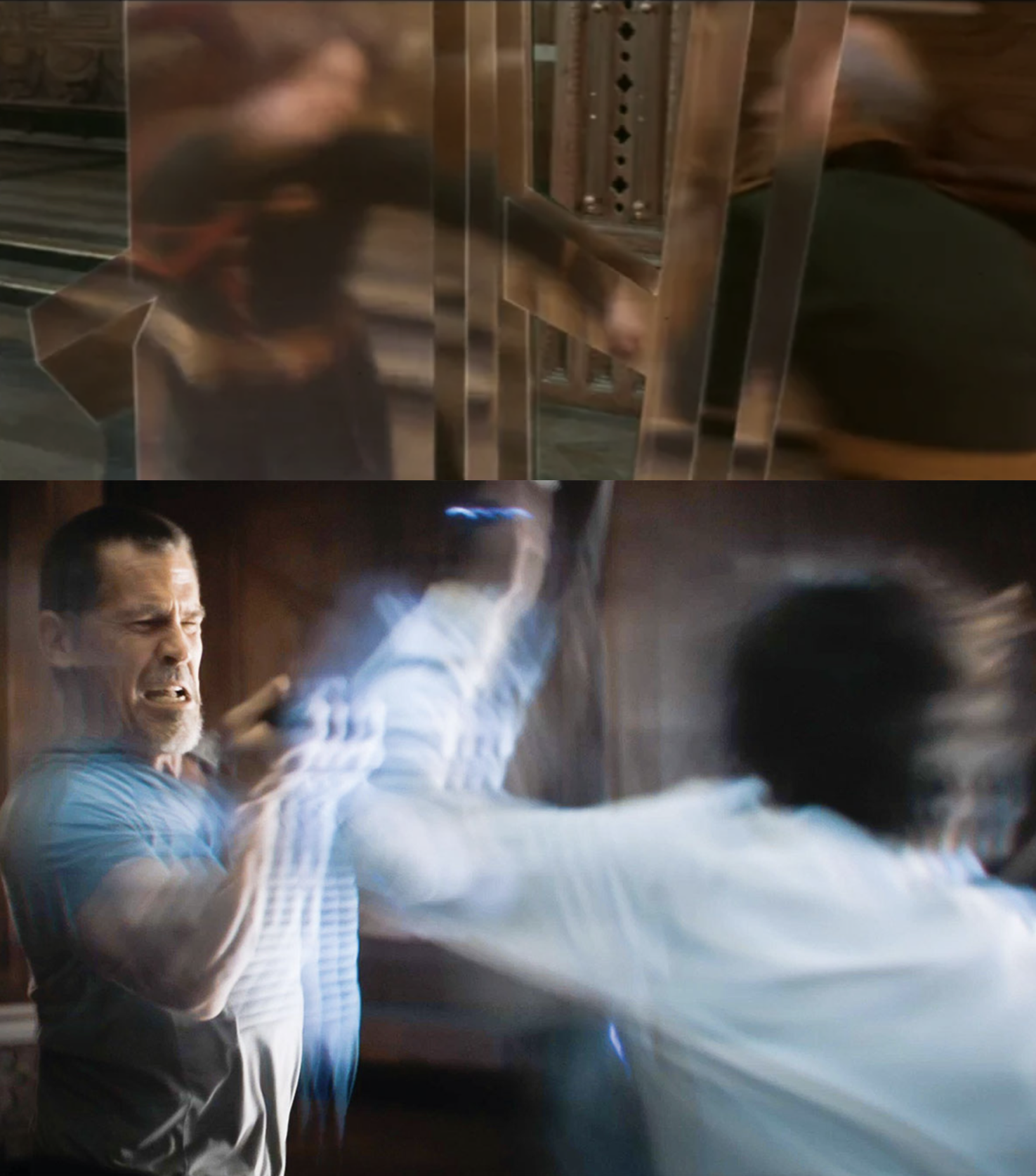
Shields are wonderful at keeping you safe except for when –
– the enemy has clever slow-bullet guns that pause politely at the shield’s edge to tunnel inexorably in, like something out of an Edgar Allen Poe story;
– the enemy has lasers, because when a laser hits a shield you get an atomic-style explosion;
– you’re out in Arrakis’s Wild Manhood Testing Country, where they attract frenzied worm attacks;
– you can’t use your shield and you have to knife-fight anyway, in which case your “slow on attack” training gets in your way.
…still, everyone uses them all the time. You can see who is the master of their technology and who is mastered by it by how they behave when the technology doesn’t.
See also the Imperial doctors’ Pyretic Conscience (which doesn’t work), the Guild’s precognition (spoofable by Tleilaxu, but then so is everything), Hawat’s security searches for assassins (didn’t look in the cupboard) etc etc.
Aside from generating dramatic tension and highlighting the fallibility of the best-laid plans (a fallibility that is necessary to the whole Fremen uprising plot) this is a classic game design principle: if you add something super strong, give it an Achilles heel.
What can we do with this? Well most of all, think of weaknesses for all the major Classes (BG, Mentat, Swordmaster, Doctor) that brings them back in line with the Sardaukar and Harkonnnens. The classic Dune move is to make people too confident in their strengths. But a Bene Gesserit can’t mind-read a typed note or an ignorant emissary (Doctor Yueh deliberately clouds the Bene Gesserit Jessica’s observations by manufacturing an embarrassing situation), a Mentat can quickly get lost in paranoid mirror-mazes, Swordmasters rely on faster-than-thought training that can be exploited

and Doctors… well, they care too much. Similarly the fastest ornithopter shouldn’t be the most maneuverable, the biggest worm shouldn’t be the most tractable etc.
Maybe the biggest sinew, though, is to replace machines with people. The Mentat as human computer has already been mentioned, but the motif is everywhere. Why have a scripture when you can have oral traditions? Why a recording device when it could be a person with eidetic memory? Conceivably, you could replace weapons, horses, cars and telephones with talented humans. I would say furniture, but that’s a bit too Book 5 for this post. Or mix the functions up: a Bene Gesserit is in many ways a social Mentat – their skills at manipulation, cold reading, and masking their own signals make them a technology of persuasion. Someone who was able to open doors into gatherings could be social harvester, someone who can keep things secret might be an information swordmaster. I dunno, maybe this is all too JoJo but Dune has so many little superpowers, lightly explained that I think you could really go wild with inventing new ones.
3: Space Splice
While we’re on the topic of replacing machines with people, have you ever noticed that the spaceship computers in Classic Traveller are generally the size of a stateroom? You could easily replace them with the living quarters for a Mentat (Wizard of Oz curtain optional), with bigger ships requiring higher-status mentats who demand more palatial accommodations, according to strict sumptuary laws.
Herbert does not explain how the Guild achieves interstellar travel…. until Book 5, which came out a year after Lynch’s movie, and which gives the same explanation Lynch gives: the Guild Navigators “fold space,” using their esoteric mind visions. So that’s neat: the Jump Drive is also a person, with bulky quarters full of spice gas. Dune’s Guild has a monopoly on interstellar travel, though, so there would be no jump drives except for the gigantic Guild Heighliners.
It is curious, though, that Herbert doesn’t explain how interstellar travel works until Book 5, 20 years into writing the novels, because:
1. everyone else who writes an interstellar empire epic in the 20th century offers an explanation for how it’s supposed to work – Jump drives or Hyperspace or Warp or interdimensional gates or corridors. Everyone has their own way of kowtowing to Einstein’s assertion that you can’t go faster than light, and then saying “here’s how we’re ignoring it.”
2. the rest of Dune is so damn didactic. It’s the perfect book for high school analysis essays because you can say “Herbert thinks struggle makes you stronger because he says so, first on page 26 through the mouth of Leto, then on page 27 directly via the omniscient narrator.”
But when it comes to how the empire is tied together, what the Guild’s all-important monopoly rests on… nothing. Except that Guild Navigators needed Spice to “see a safe path” – because if you’re going really fast, you don’t want to run into any pebbles. Or hydrogen.
So… maybe this is overreaching (although if anyone ever invited a Talmudic/Koranic exegesis of their novels, it’s Frank Herbert) but… what if Herbert kept quiet about this not because he himself was ignorant or uninterested in the Einsteinian problem but because he wanted to maintain the mystique of the Guild? No-one outside the Guild knows how the Guild does it. More than that, what if the point was, nobody in the Duniverse knows FTL travel might be a problem because they don’t have the scientific background? In Dune’s lore, the 5 great schools of knowledge (Swords, Doctors, Mentats, Bene Gesserit, Guild) are set up after the Butlerian Jihad, which was fought against computer AIs. Developing computers requires Einstein, quantum mechanics, and higher math. So… the schools restrict access to science and (to be safe) calculus. The rest of Dune is socially… what? 16th century? In our own history it takes about 300 years to get from there to Einstein. How would you prevent that development for 10,000 years? By funneling everyone into very deliberately constructed educational pathways and teaching them curricula that neatly sidestep the required questions, then giving the guardians of various fields of knowledge social positions they want to defend, that come with neatly circumscribed professional formations. Herbert is obsessed with mental and social conditioning and he specifically mentions that doctors and mentats have trained restrictions. The other hint here is that the Great Houses’ “family atomics” are all supposed to be 10,000 years old – irreplaceable relics of the Jihad (and Dune was written at a time when the discourse of nukes was that they lasted forever). So: only the Guild school is entrusted with relativity. …and, probably, with Maxwell’s equations for electricity and light, which were what set Einstein off in the first place. And only the Ixians and Tleilaxu disobey the restriction and they keep very quiet about it for their own mnopolistic reasons.
All that said, fundamentally, the situation offered is actually quite familiar for gamers:
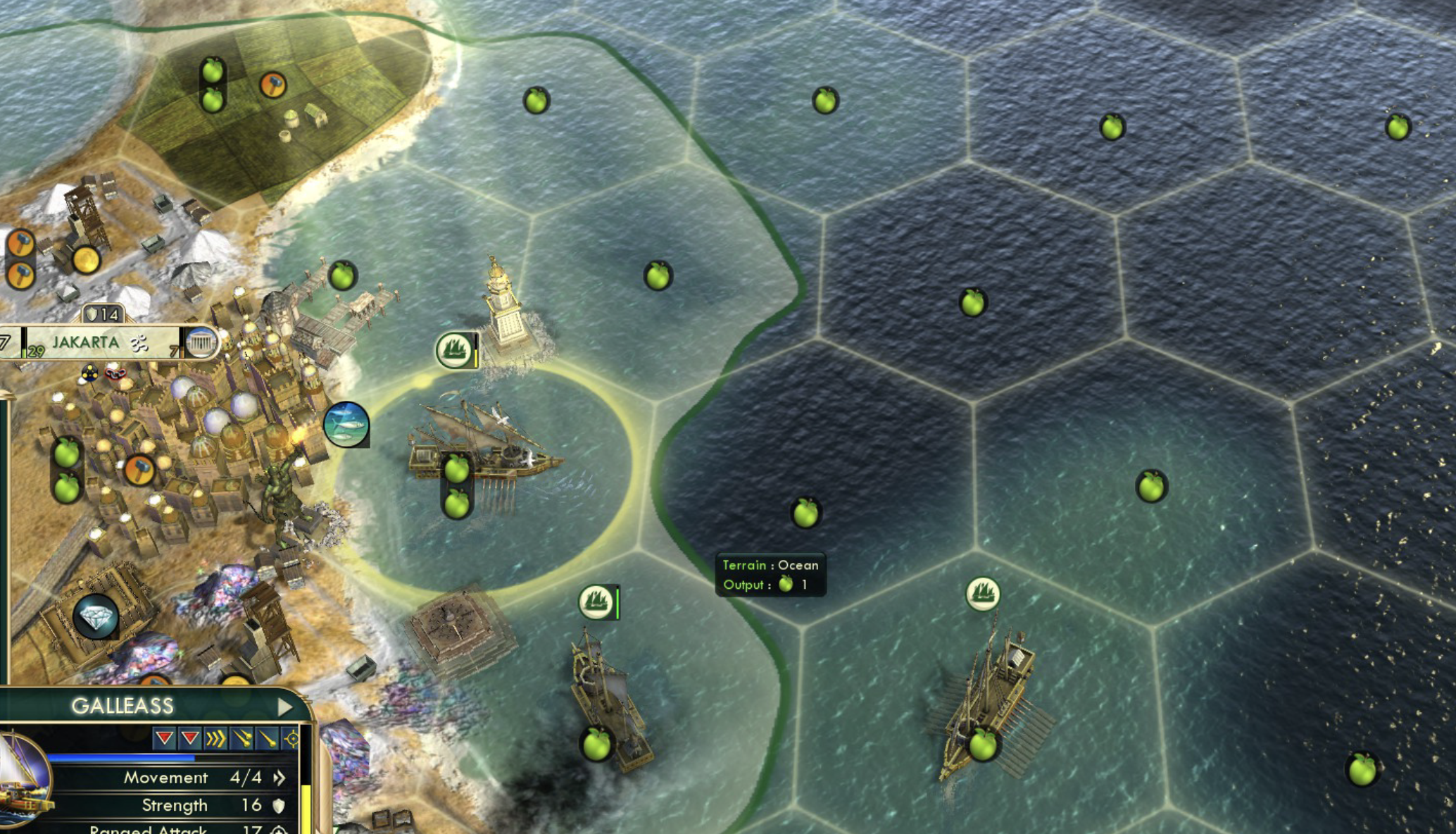
Travel within a star system is “shallow water” – anyone with a simple spaceworthy craft can do it (Houses, smugglers, assassins etc). Going from one star system to another is “deep water” and requires a Guild Heighliner.
I say that, but I can’t actually remember Dune ever taking advantage of multiple points of interest in a single system (in the book it seems that the Guild actually restricts Houses’ rights to fly their own ships around, which makes me wonder how much of a capital drain a space warship is on a House that can hardly ever use it). Which is too bad, because star systems could get really diverse: “shallow” could be a busy star system with twelve warring planets, or several moons around a single gas giant, or a lively asteroid field for mining. It could also be an enormous nebula, a couple of light years wide, populated with enough gas and little rocks and radiation and brown dwarfs to keep tramp ships powered and occupied for decades. (Nebulae could even be no-go zones for the Guild’s big hazard-averse ships).

(BTW the shallow/deep divide in Civ has no physical justification except that “shallow” might mean “easily accessible to an unidentified harbour of retreat,” so in theory unstable ships like galleys could run to shelter from storms from the “shallows” but would be forced to ride those storms out in the “deeps.” but don’t let that worry you, it’s a wonderful bit of game design anyway to be able to see the excitement over there but then have to devise an ingenious method for getting to it.)
There are many ways to set a shallow/deep division up – maybe you need a special ship or map, or only a native guide can get you across the deep desert, or only a government cyberdeck can get you into the government’s servers… the point is you have to work with the Church to get into its Treasury. Imagine Han Solo in this situation: he can smuggle all around the solar system but if he wants to get from Tatooine to Alderaan, he needs to forge papers or bribe an official, get on a Heighliner and “fly casual” right under the nose of the Grand Moffs who are coming back from obliterating Alderaan a moment before. Because also people can see who else is on a Heighliner but they can’t do anything about it without endangering their travel privileges. Imagine the Guild letting people off at a system that no longer has a trading planet, or being evasive and dropping them at the wrong destination. A Death Star could only exist if the Guild were complicit in the Emperor’s planet-busting reign of terror or if a rogue splinter-Guild drove it around, causing a crisis in everyone’s confidence in Guild neutrality/ethics/reliability/violence.
4. Dune, Ripple, Wave
Finally, I guess I’ve already tipped my hand to this one but of course, Dune’s shallow/deep structure, like everything else about Dune, could work at any scale.
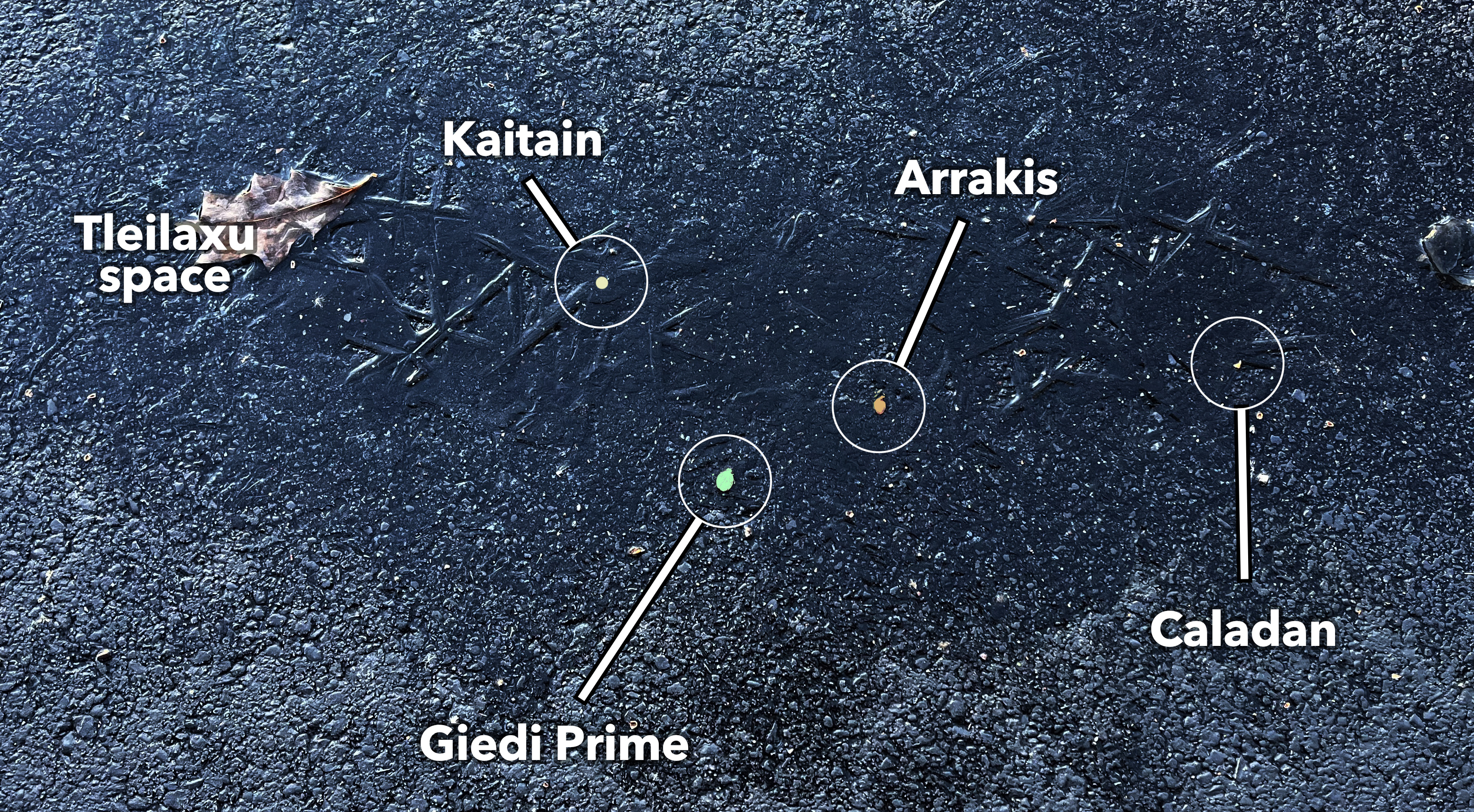
The stated scale – galactic spread, billions of unmentioned subjects – presents all sorts of problems (that Herbert doesn’t address), but an ocean or a big sky full of Flash Gordon flying islands or whatever could give you the same fun. Shallow could be estuaries, archipelagos, reefs, tower blocks, subway stations, university departments – any space that’s somehow bounded, where connecting to another such space offers a different challenge from getting around the current one. The point is that if you get the sinews right, you could reskin and rescale Dune in all sorts of ways to fit your home gaming group and still get a recognizably Duney campaign.
What if you reskinned Dune just lightly, to play up the early modern exploration vibe and play down the (clearly uncomfortable) sciencey part of the fiction?
It is the long 16th century – somewhere between 1480 and 1648 – and everything and everyone you find in that span is fair game. The Emperor, Charles-Philip of Spain, is bent on spreading his rule across all the unknown realms of the universe – both those across the seas and those of Angels and Devils. He has become so powerful that he threatens the unity of the Holy Mother Guild and it is rumoured some Cardinal Navigators have promised to open up their routes for him, to the Outer Spheres, where the Angelic Guild Superiors keep their fruitful kingdoms and permanent warehouses.
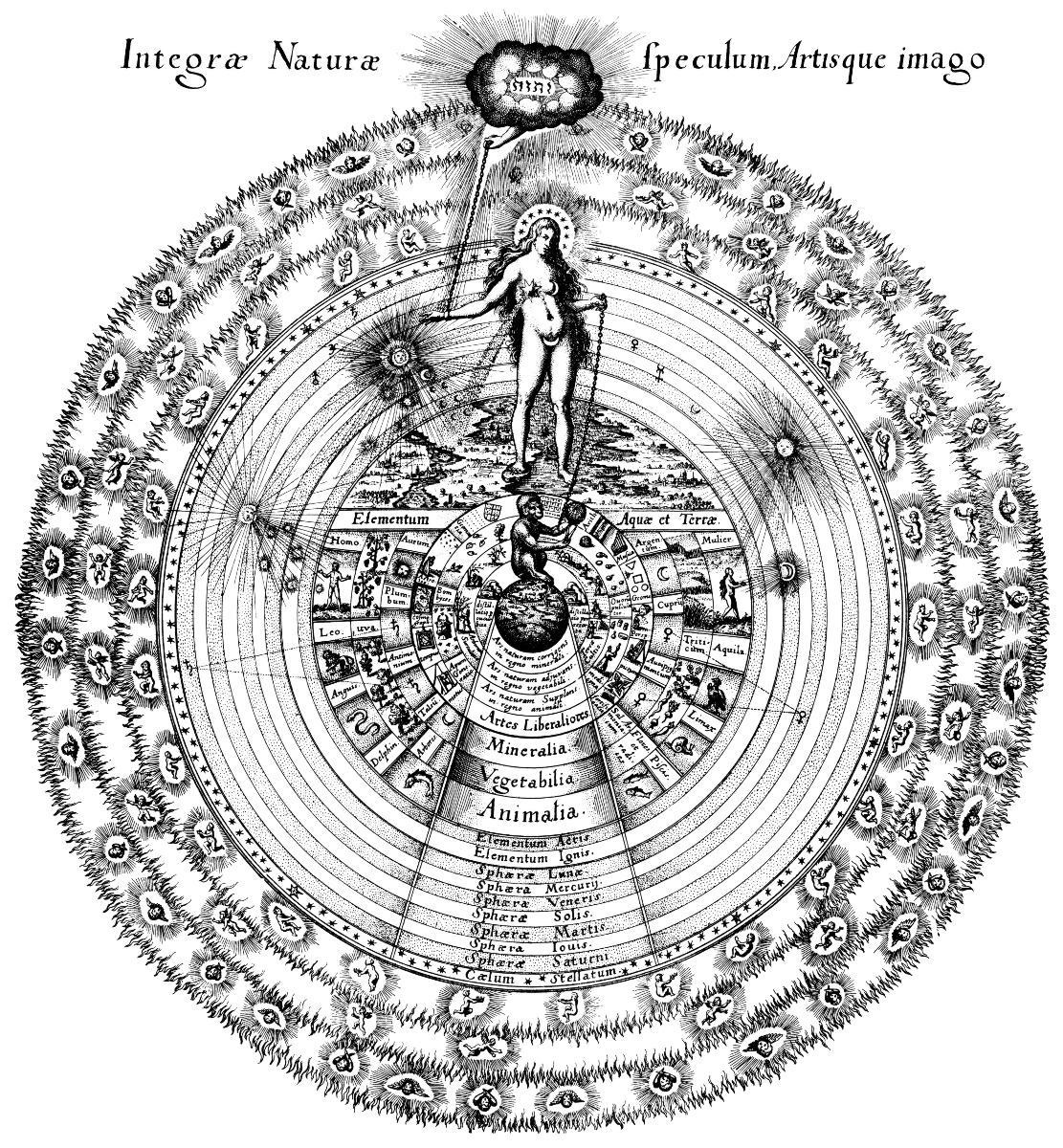
Only a coalition of the Great Houses (Tudor, Valois-Angoulême, Ottoman, Syah, the Bohemian and Austrian Habsburgs, etc) can stop him, and then only if they can keep him from discovering the sources of Radiant Spice, for which the Guild thirsts. Rumours abound of Spice sources across the seas:
– fountains of youth,
– cities of Brass and Djinn,
– Ambergris floating on the foam,
– islands made from a single nutmeg, from which all other nutmegs grow,
…and of Other Worlds offering trade and conquest:
– El Dorado,
– Far Cathay,
– Agartha,
– Hy-Brazil,
– St. Brendan’s Isle
– the paradisical Isle of Pines.
Any of them could seduce the Guild to the Emperor’s path, all of them are said to offer a way to the fabled Prime Mover and a Great Synthesis – if Charles-Philip could reach that, he would become sole and eternal Emperor of all.
The Mentats John Dee and Ignatius of Loyola translate the secret languages of the Angel Guild for their respective rulers. Giordano Bruno, kept captive in the Guild Embassy in Rome, charts the empire-to-be in his Memory Palace.
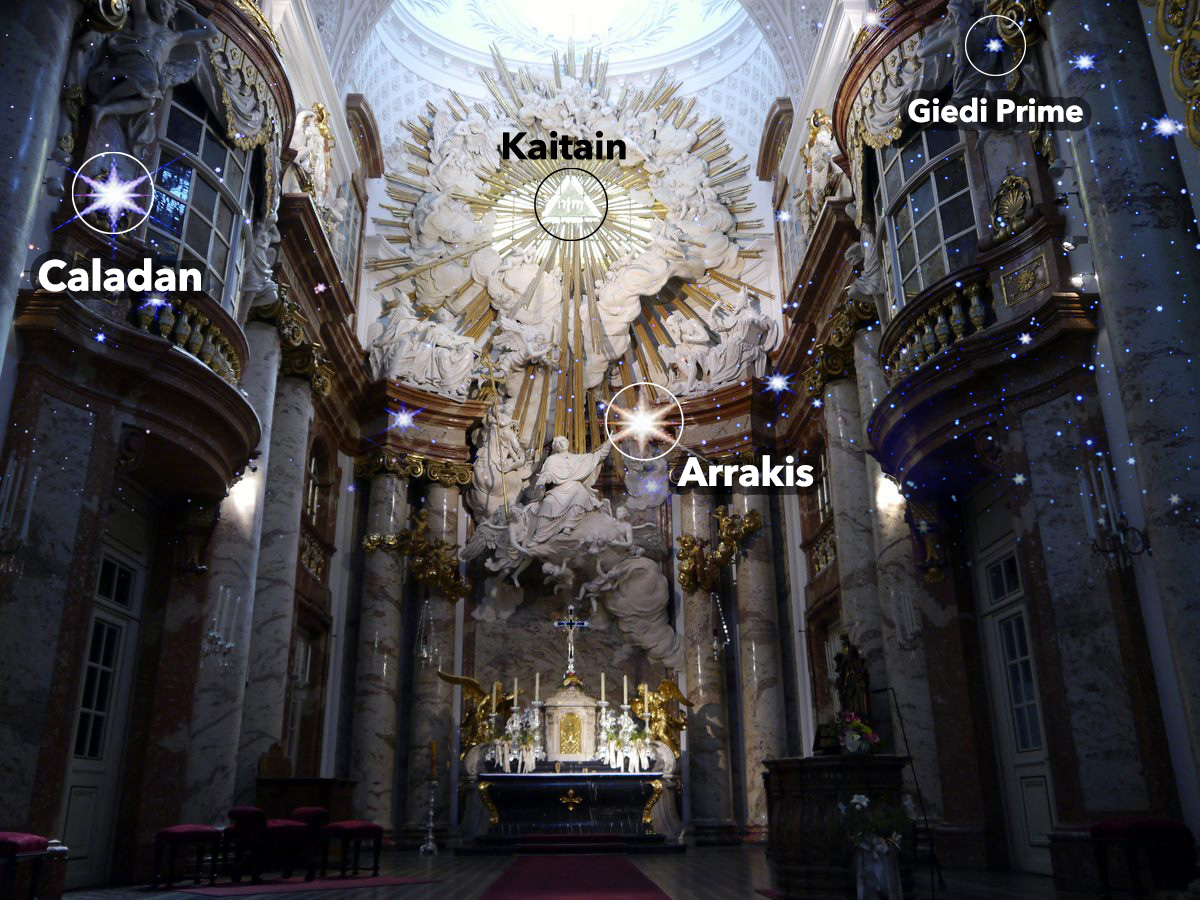
The Bene Gesserit are a secret sisterhood of basically every woman you’ve heard of from the period – it is rumoured that all women are members, whether they know it or not, especially all the wives, mistresses and wetnurses of royalty. Known Reverend Mothers include Isabella of Castille (the Emperor’s long-lived grandmother), Elizabeth and Mary Tudor, Artemisia Gentilleschi, Aphra Behn… and the Missionaria Protectiva are said to have been active among the Amazons of Benin and the Wonhwa of Joseon.
This proto-Dune hovers on the brink of the long-term stability that Herbert’s book tears down: the Spice monopoly is still out in the rumoured wilderness and up for grabs. The most vicious fights are over speculation – about where the Spice might be, about what it might unlock. The Guild still controls access to eternal life, though, and nobody (yet) dares to openly defy it, even as they try to tease its members away into supportive splinter sects.

next: Post 3: Dune Mashups
Wind, Sand and Stars: reconstructing Dune pt. 1
Villeneuve’s Dune follows the dictum “art is deletion.” The director loves nearly-flat textures and deep bass drones and minimalism and brutalism and the Bene Gesserit

and deletes much of the rest – the Guild, Mentats, Herbert’s eccentric approach to scifi, computers, and space travel, the Duniverse’s long, repetitive history of Jihad.
Bravo. A strong editorial hand is simply necessary for making a film out of Herbert’s sprawling, invention-filled novels. You can’t make a Dune film without breaking ergs.
But that leaves a lot of potential Dunes on the cutting-room floor. So this post and the one after it are about other choices you could make to construct a campaign out of Dune’s ingredients.
Also, I have a sense that some players are reluctant to engage with Dune, either because they think they need to learn a wall of lore or because they don’t find it inhabitable. Han Solo opened up a giant door into Star Wars – you didn’t need to be an Important Person, you didn’t need a ready-made destiny plot, you could just be smuggling around the galaxy, fixing your jump drive with a kick, shooting scaly anteaters in dive bars. My hope is that these posts might open up some doors into what Dune has to offer – how you could play as someone other than Paul. In terms of scope, I too am afraid of the wall of lore that Dune develops in its later volumes. I restrict myself to the first 2 books, the bit covered by Villeneuve’s trilogy.
The title of this post, BTW, is stolen from Saint-Exupéry’s memoir of delirious revelations he had concerning the state of humanity, machines, and God while stumbling away from a plane crash in the Sahara. He fell from the sky and was rescued by Bedouin and felt himself stripped of everything but his humanity and maybe some wisps of divine protection.

I highly recommend it as fuel for a dream-logic Dune, connected by spore-tendrils to Frank Herbert’s blue-tinged musings on consciousness-expansion.
The Ingredients
Film schools tend to teach that stories are made out of characters, plot and setting, in that priority order. Get the characters right, you’re fine. Have them do some plot while you’re learning who they are. Nice. The setting is tertiary and basically interchangeable.
I think that’s why SF and fantasy movies so often come out wrong – they put setting at the bottom of the pile, when setting is the reason why a story is SF or fantasy. What if, instead, we think about stories having a heart (the reason the story exists), a skeleton (structure, often borrowed), and sinews – the parts that mobilize the narrative, that drive it along, provide reasons and resolutions. Those sinews are often lumped in with setting but they’re not the same: setting is kinda akin to fluff, sinews to crunch. You might be able to reskin a setting, but only if you get the sinews right, because they make it work. The ingredients I’m interested in are the sinews.
But let’s get the heart out of the way first. Dune is, like Star Wars, mostly a pastiche, and superficially the two look identical: little guys against a big empire (a familiar theme around here).* Original Star Wars’s heart is Kurosawa Samurai epics plus Dambusters or, to put it another way, “honor and daring ingenuity can beat any giant structure.” People talk about SW being good vs evil but the goodness of the heroes (and even the specialness of Jedi), especially in the first outing, is secondary to their quality of daring, of defying the odds and doing it anyway. Dune’s heart is Lawrence of Arabia:** “every triumph contains the seed of its own destruction.” And the more absolutely you start out as the hero, the more certain you are to become an agent of villainy. In Lawrence it’s super explicit: his success before the intermission is punished after it. And retrospectively you can see his failure was always there, waiting to be expressed. Dune makes it explicit by having characters who can see the future, so it doesn’t have to be retrospective: Paul, the Bene Gesserit, and various others can see the tragic arc, the rot in the bud, at every moment. They can sense the destination but they take the journey anyway.
* obviously I’m only talking about the first Dune book and the first SW movie here… well, maybe the first SW trilogy. We do not speak of anything above the number 3, ever.
** I mean only the movie Lawrence of Arabia, which is different in many ways from the memoir from which it draws. Movie Lawrence’s heart is partly borrowed from Kipling’s The Man Who Would Be King. And the movie of that is also a very good companion piece for all of this. It should clear up any confusion about whether Paul’s a straightforward White Saviour (he isn’t).
Also yes I know, both Lawrence and The Sabres of Paradise are cited as literary inspirations for Dune. When I’ve read Sabres I’ll get back to you about what its heart is.
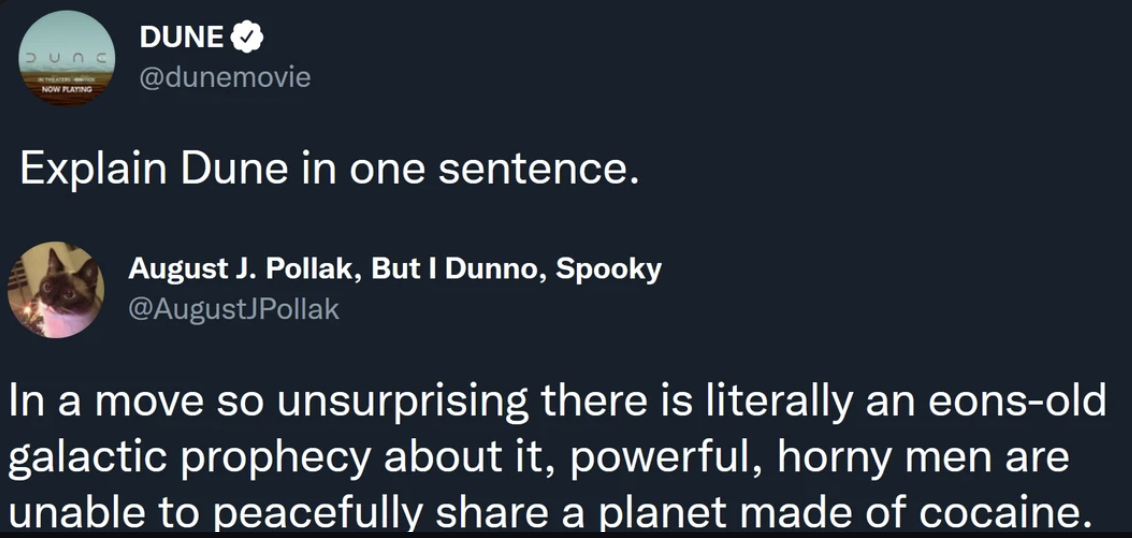
But Dune is not only that Big Theme, it’s also things revealed to Herbert by magic mushrooms (Jungian things about the wise power of women; eccentric things about how gay men are destined to go into the army). They’re a grab-bag but for Herbert they’re all Deep Truths. Mankind as a species is threatened by stagnation. An unexamined life is not worth living. Machines and comfort are counter-evolutionary. Nothing boosts growth like death. Nietzschean type stuff, mostly. And those things are what the sinews express.
1: Factions
Instead of Star Wars’s unitary Evil Empire, Dune offers a giant cage match of multiple, cross-cutting power interests with specialized realms of control and unique abilities, like highland Sri Lanka or the video game Hero’s Hour. Here’s the special thing Dune brings to this: even though they have different aims and they play on different chessboards, these factions can only make temporary alliances because they’re working towards philosophical/eschatological end-games, that only they really understand. Each one believes they must be in control, and soon, before the next apocalypse. Everyone has heard about the last apocalypse 10,000 years ago and is sure another one is just around the corner. When it comes, all mankind will be glad that they, faction (X), are in control.
The most familiar chessboard contains the Great Houses and the Emperor who are pretty much the Holy Roman Empire but spread over a galaxy. Compare them with Game of Thrones: the Houses compete in marriage, diplomacy and war. They have special strengths and weaknesses (and you can make more up at will). The visible parts of their courts are also the same size as GoT’s Houses – a nuclear family, a few servants, an advisor. Dune’s Houses are distinctive in also having hereditary bureaucratic functions, so imagine, say, the Harkonnens as the Bushes, with ancestral control over the CIA, and the Atreides as the Kennedys, born to run the State Department. Or the Tafts as the IRS dynasty. Houses could have any weird eschatology you can dream up but they’re mostly all worried that the Emperor isn’t doing a good job of staving off the apocalypse, so he must be replaced. Coincidentally becoming emperor would allow a House to pay off its enormous debts to over-mighty bankers from the Imperial coffers.
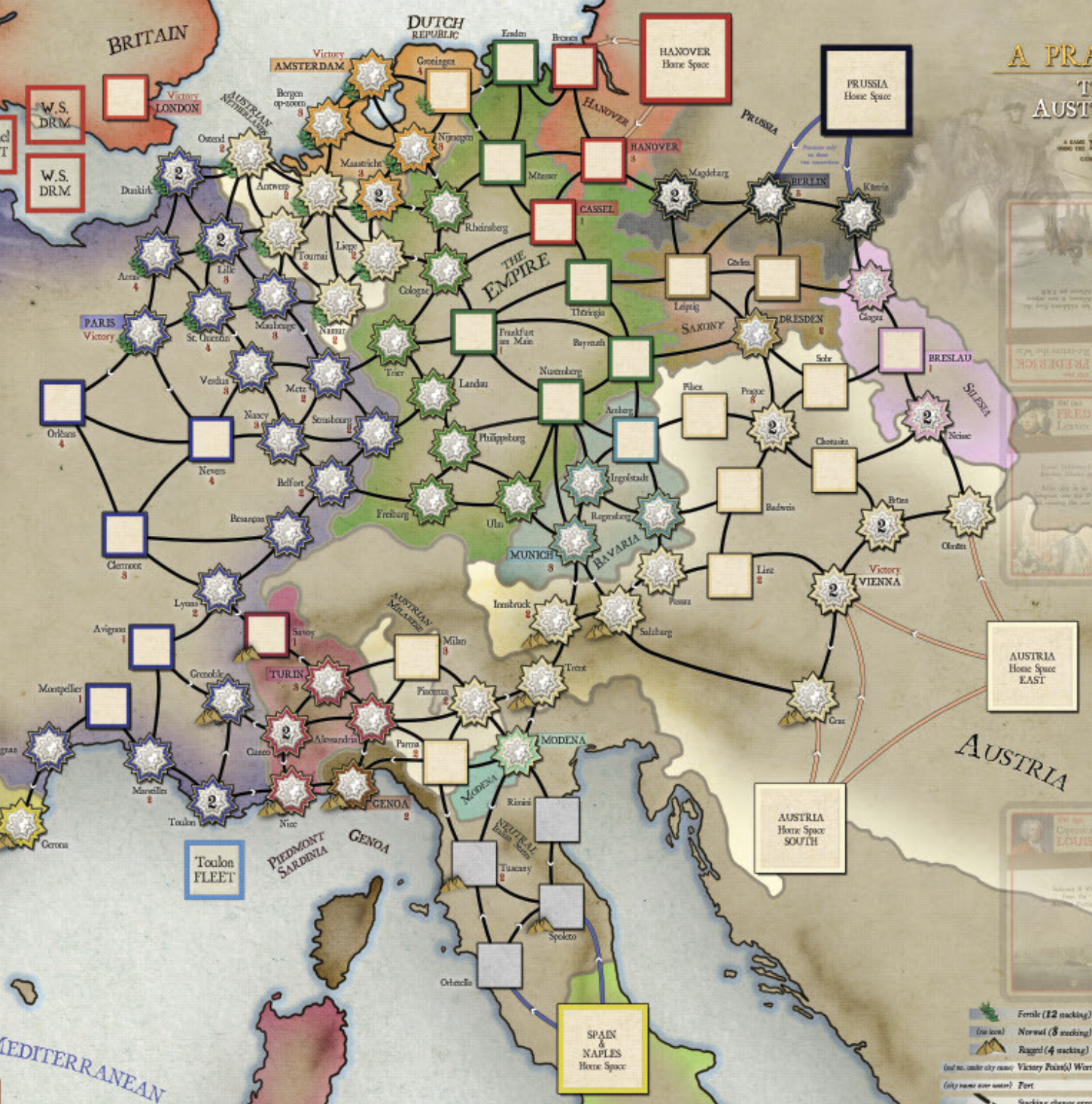
Dune’s special sauce here, which changes everything, is that the Houses and Emperor are in a political tripod with CHOAM – the honorable company that holds a monopoly on all interstellar trade and which controls (like OPEC) the flow of Spice. (the full name, Combine Honnete Ober Advancer Mercantiles, means exactly the previous sentence) Real power (and unlimited money) comes from a directorship in CHOAM. CHOAM locks the Houses together: no matter how many of your children they’ve killed, you still have to cooperate with the other CHOAM directors, or nobody gets profits. And CHOAM depends on (is really an arm of) The Guild, which has a (near?) monopoly on interstellar transport. (CHOAM also incidentally recasts all the Houses as colonists of their homeworlds rather than feudal fiefholders – they’re concerned with cash crops for the external market).
Of course the Guild keeps its closest eye on the Emperor, who can dispense great gifts (like contracts for Arrakis) but can’t hold onto them, making him maybe more of a Trobriand Island chieftain than a Habsburg or a Roman-style emperor.

Being Emperor is like being a noble but more so: first among equals, he has no friends. There’s no step up, only down. And his Sardaukar legions are like Varangian guards or the Caliph’s mamluks – they’re the world’s strongest army so they’re well placed to seize power themselves.
The Guild controls all interstellar transport and has its own bureaucracy, training school, religion, and god knows what else. It’s ruled by Guild Navigators, who can see the future and don’t like it. They know they’ll never be more profitable than they are right now, and right now their profits depend on their transport monopoly, which in turn depends on:
(a) a technological edge – giant interstellar-capable ships;
(b) Spice – a drug that lets you travel safely between stars if you get high enough and have spent centuries turning yourself into a Guild Navigator.
If anyone else replicates these technologies, the Guild’s profits will plummet and it will lose its stranglehold (through CHOAM) on money and politics.
So the Guild spies on everyone to make sure they’re not developing transport or spice-like technologies, and tries to maintain stability while knowing that there’s nothing harder than preventing change on a big historical scale.
Things that makes the Guild interesting as a faction:
– better spying via mysterious future-sight, which is largely “seeing probable outcomes.”
– unmatched mobility and secrecy – the Guild knows whom it has transported and to where, but nobody else knows where the Guild’s ships are. They could be servicing a whole other Empire for all the nobles know. There are hints that they service some planetary systems that aren’t part of the Empire but are… in hiding? In wait? Supplying secret goods?
– truly unpredictable political alliances. They alone don’t want to be Emperor instead of the Emperor. Maybe they want to replace the Emperor with a more secure or weaker one but only to keep the Houses out of their business.
– highly predictable triggers: they don’t want innovation, especially in spaceship technologies. They want to control every gram of Spice. They don’t want anyone to know things they don’t know.
But…
– they’re total unable to hide their nature. Their top ranks have mutated (gotta say I like Lynch’s interpretation, which looks utterly inhuman) so they have to do any spy work through intermediaries.
– they’re totally dependent on huffing enormous, expensive vats of Spice, which have to be continually replenished. The Spice must flow because without it (a) there is no space empire, but also (b) the Guild will come down off their millenia-long high like lizards falling off Balinese palace walls.
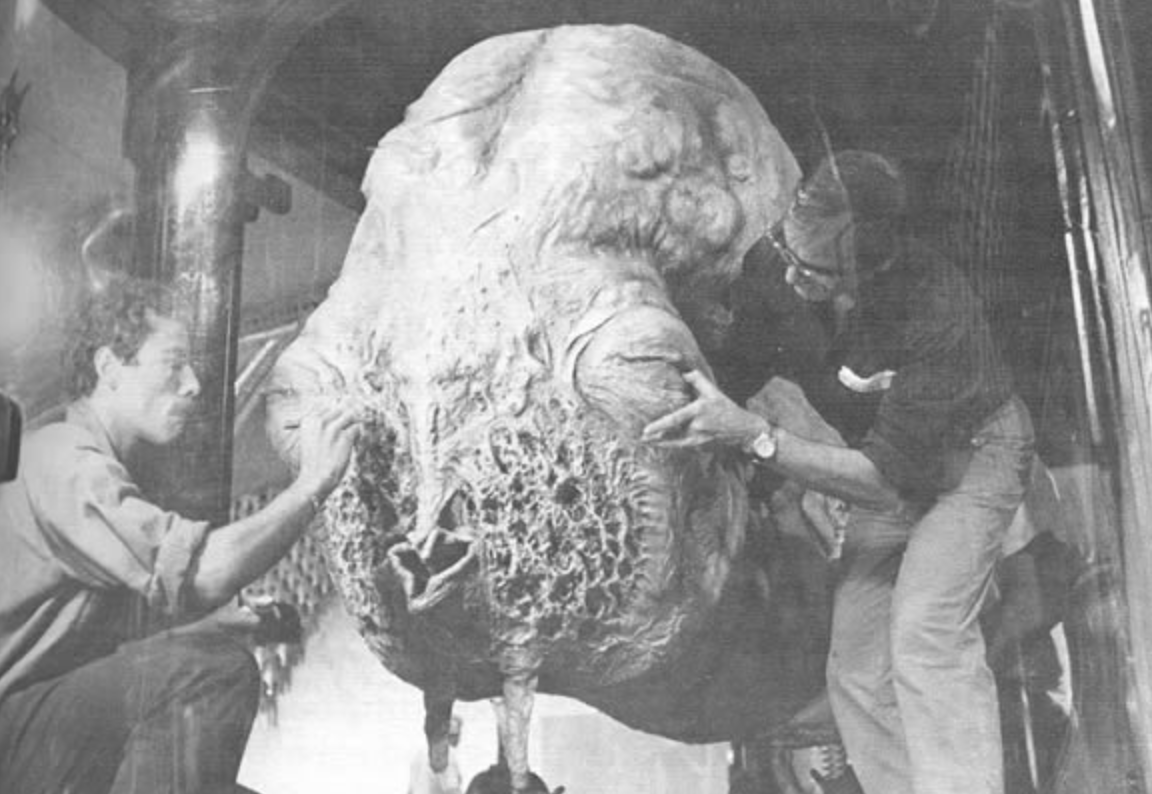
The political tripod has some interesting effects on war and diplomacy. Outright war between Houses requires armies to be transported by the Guild, and nobody can afford to be cut off by the Guild, so any war-fighting has to be negotiated with them first – you don’t want your invasion force to be denied a ride back home. The Guild is “strictly neutral” but even more strictly in favour of long-term stability (which might involve removing you, troublesome Duke!). So you tend to get limited wars – mostly of spies and assassins, mostly leading to situations the Guild considers more stable. That’s one reason why CHOAM directorships are the real Victory Points – you don’t have to transport them.
So playing a noble or seneschal of a House really offers three modes, that you can slip between for different situations.
- Out in the provinces, where the Guild doesn’t care so much what you do, it’s like Game of Thrones: each House stands atop ornery, maybe rebellious subjects, and other Houses’ assassins could blame a noble’s death on their own local troubles. Spying on what other Houses are doing is a survival tactic. Being able to report anything improper to the Emperor or Guild is a bargaining chip.
- In formal settings, like the Emperor’s Court, you’re under the full glare of Diplomacy but you’re also doing all the business of Dynasty, so think of the betrayals and ridicules of Versailles, the intrigues of Richelieu, hurried missions for Musketeers that have to be completed before the next public Ball. Outright assassination at the Imperial Court is liable to spook the Guild but making others look like bad partners/marriage prospects is exactly what it’s all about.
- CHOAM meetings are about trade negotiations and shipping contracts, which means doing favours for Guild ministers and competing to sell your goods across the Galaxy in preference to the goods of other Houses. Interstellar shipping is very expensive, so those goods will all be either great luxuries or special innovations your finest engineers have dreamed up… as long as they don’t stray anywhere near long-haul spaceship tech or computing (more on that below). Most of all, though, CHOAM meetings are about getting access to Spice. The Guild is the biggest customer, but everyone wants Spice because it extends life. So obviously the Dukes and Barons want it but it’s also the best thing in the world for keeping their advisors, administrators and army chiefs loyal. Assassinations at CHOAM meetings seem like a very bad idea, and social standing/reputation probably doesn’t matter so much to the hard-nosed Guild, but there’s still plenty of room for soft power: Guildsmen are still men, and the bigger an institution is, the more you can hide in its folds. The more human-looking Guild administrators probably chafe at the glass ceiling imposed by the Navigators. Within the Guild, the right to Navigate might be a system of dead men’s shoes, and nobody is better placed for smuggling than a Guild representative. If, in fact, the Guild is based at all on the East India Companies, then smuggling might take up more than half its shipping capacity.
Mentats are what Dune has instead of computers, and I think dramatically they’re way better: why have a mute, reliable machine holding your information when it could be a self-interested human? Whether they’re venal, corrupt, and blackmailable or idealistic, credulous, and biased, a Mentat offers so many more handles for a DM when imparting information to players.
of course, where you have continuous wars of assassins, you want your assassins and security under a Macchiavelli-style Mentat and, as usual, to complicate things, Herbert has them all train at the same school, making them a faction as well as a technology (next post).
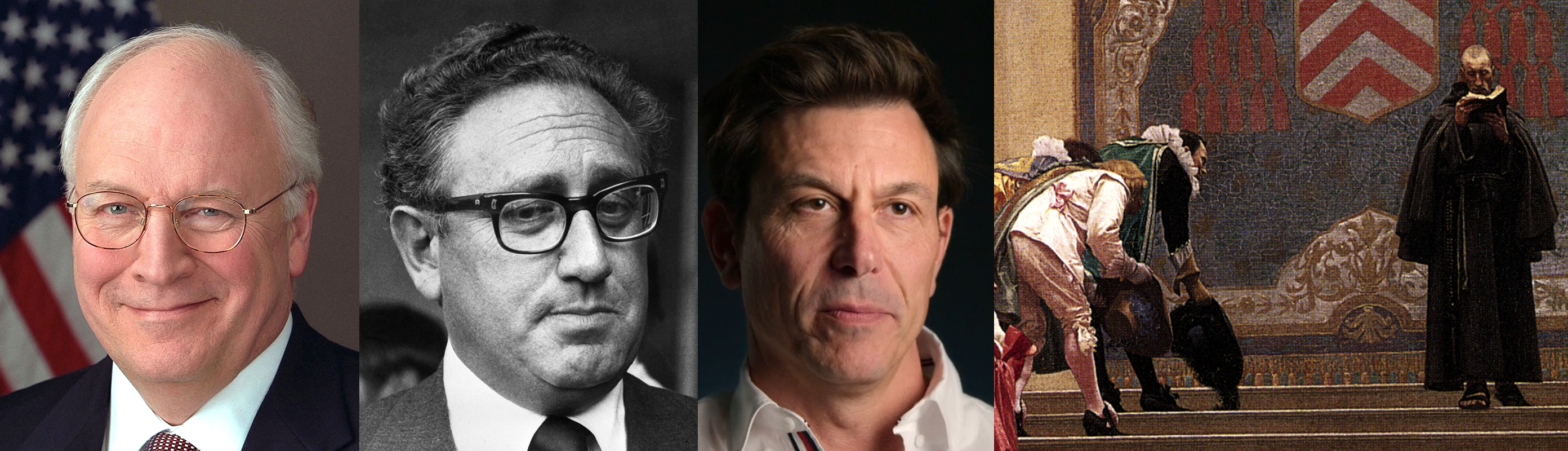
That means they tend to know each other and have their own agendas and jealousies – the Harkonnens’ Mentat deliberately trolls his Atreides counterpart – partly to keep him distracted, partly for personal amusement. In theory, Mentats are supposed to be inherently ethical in their advice, but watch out! Herbert says there are also twisted Mentats, who aren’t. This is as close as Dune gets to a light side/dark side schism. Note that even “ethical” Mentats deploy assassins.
Factionally (and reasonably) they all distrust and work semi-collectively against the Guild and the Bene Gesserit, recognizing that both are up to stuff they don’t want anyone else to guess at. The Guild always wants to puppet the Houses; the Mentats are the Houses’ counter-measures. The Bene Gesserit puppet everyone anyway.
I’d recommend using a House’s Mentat as the PCs’ first patron: the players can ask the Mentat anything and get one of 3 replies:
– here’s the information
– you’re not cleared for that
– that’s not knowable/you can reasonably expect that hardly anyone knows the answer.
Because Mentats know what’s going on and are always full of schemes, they’re the ideal mission-givers and heist organizers. And then the PCs find out in mid-heist that their Mentat’s understanding of the situation was not quite as perfect as it seemed.
Mentats also have handles for the players – they’re addicted to expensive Sapho juice (no really), which they use to sharpen their minds, and often also to Spice, since long experience is a great strength for their role. They typically work alone and it seems like a lonely position: they’re never anyone’s social equal, they’re always the smartest person in the room but never the decision-maker, and they’re professional paranoiacs, seeing openings for assassins everywhere. No wonder they are so often prey to all kinds of weird vices.
It’s probably best to work up to playing a Mentat – they’re very high level – but in terms of replicating their published powers, just give the player a calculator and an encyclopedia – or the right to make up background detail at will.

If the Great Houses are the Holy Roman Empire, the Bene Gesserit must be… eugenicist Jesuit nuns? They redefine bodily control, inflict pain in the name of restraint, and are freakishly concerned with who is having sex with whom, which all sounds a bit like someone went to Catholic school. They also spread propaganda in the guise of religious revelations, presumably aided by their trained ability to see whether people believe them or are excited by what they say.
“The Reverend Mother must combine the seductive wiles of a courtesan with the untouchable majesty of a virgin goddess, holding these attributes in tension so long as the powers of her youth endure. For when youth and beauty have gone, she will find that the place-between, once occupied by tension, has become a wellspring of cunning and resourcefulness.” – Dune
Ahem. So they’re maiden/whores until they become wily old crones. Right. I swear, Robert Graves haunts this book. They learn all this stuff in their own Great School, which seems to be a totally sealed institution: it just quietly sends forth Black Widows at odd moments and people only notice afterwards. And it seems like it sends them wherever there are people to manipulate – there are apparently several high-ranked BG reverend mothers hanging out among the Fremen, whom nobody else courts. I think we can assume they’re also witching it up in all kinds of other little ignored power islands across the Galaxy, far from the Imperial gaze.
In all the visual media they’re shown wearing strange uniforms but in the book you know a Bene Gesserit by her perfect control, measured heartbeat and occasional irresistible commands. Their eschatology is the clearest: somehow they can see the future because somehow they can access racial memories but only women’s memories and therefore not enough. So they want to selectively breed a male Bene Gesserit who will be able to see the future perfectly… and then rule the universe through him. Their end-game philosopher-emperor will have the powers of a Bene Gesserit Reverend Mother (detect lies), a Guild Navigator (future sight) and a Mentat (human computer) and will submit to the control of their own admittedly less-perfect and less-far-seeing leadership. I dunno, I can’t see the future but I think I can see a potential problem with that.
If the Bene Gesserit actually won, they would be no fun at all. But until they do, they’re frantically busy seducing nobles, stealing children, ruling from behind thrones, upsetting everyone else’s plans, and sacrificing themselves and others for secret purposes that might not mature for generations. Which is everything you could ask from a villain or an unreliable ally. At the very least, the threat of interrogation by a Bene Gesserit Truthsayer deliciously complicates any underhanded mission the PCs might have been given by their Mentat patron.
There are also Great Schools for Doctors (medics but also general researchers) and Swordmasters, so there’s your Kung Fu hero. Herbert doesn’t seem very interested in their factional possibilities and has doctors subject to intense conditioning, making them feel unspeakable pain if they’re in danger of breaching their Hippocratic Oath.
So what can we do with all this? How would we swipe it for our games or make the Duniverse more legible for our players? I note in passing that the Great Schools seem to pump out very D&D-like Classes of alumni: Swordmaster = fighter, Doctor = the medical functions of the cleric but Bene Gesserit can command/turn enemies and detect lies. The Mentat seems an obvious analogue for the Int-based wizard but their spells are all of divination. Thieves/assassins are strangely absent from the basic Class roster, but maybe that means everyone has those skills, or maybe just nobles do.
There are several key points to learn from Dune’s factions for court intrigue games:
- Every time you do something, at least 3 factions are involved. If you assassinate a prince or steal a baby or bribe a trusted lackey, the affected House and their Mentat will be interested, obviously, but also there will be Bene Gesserit links because you don’t get to be noble if you’re not breeding material, and the Guild will be worried lest you trouble the status quo. At the same time, if they can, the Mentat, Bene Gesserit and Guild might present themselves as complicating allies, if they think you could serve their interests as well.
- interlocking interests make plots and the Guild + Houses is an infinite plot generator. This is essentially what Vincent Baker says in Apocalypse World with his PC-NPC triangles: if you have 2 NPCs they will have overlapping or conflicting interests, so if one asks you do something, the other will object or want a piece of it for themselves or something. Complexity = conflict = drama. But Dune actually makes that easier by having a stable NPC entity you need to consider every time, so it’s not “I didn’t know Jo wanted this necklace too!” it’s “that princeling has a Bene Gesserit mother. Her whole Order is trying to control this family and they will come down on us if we aren’t careful.”
- Which is to say: familiar pieces help you play chess. You don’t know what the Bene Gesserit want with this prince in particular, but you know broadly what sorts of things they’re concerned with: marriages, alliances, Truth-detection, pregnancies. Likewise the Guild: balance the Houses to keep them all weak, no obstacles to the Guild’s own operations, no new machines. If you’ve spent time introducing characters, keep reusing the same people. Politics is personal; if your players know the Guild ambassador is having to restrain his anger because of what they did last session, you’re winning as a DM. On the other hand, Dune’s institutions allow you replace individuals to great effect. So you killed the last Guild dude? Here’s a new one and he wants to know what happened to his predecessor and why. Remember also that everyone has trouble controlling their people – maybe the dead Bene Gesserit agent overstretched herself? Maybe she was on a secret mission the replacement doesn’t know about? The replacement will not automatically be an enemy.
- Even though Herbert keeps saying “ohohoho plans within plans,” actually much of what happens is improvised and paranoid knee-jerk reaction. Each faction has its long-term goal to keep it busy, but they’re also thrashing about dealing with whatever just happened and attributing it to the other factions. For the players, remember: if you cause a bit of chaos, that will usually give you time to get away. Also you know enough to pursue your own goals. If they intersect with someone else’s goals, that someone will first approach you and try to work out a deal, because acting directly against you will probably be more damaging for their plans.
- Have a Mentat or Bene Gesserit agent the PCs can consult. They start by hiring the PCs for a bit of work. That way the players can find out about the politics little by little and from information they collect themselves. Don’t infodump, don’t betray them on the first mission, let them figure out enough that they can see traps coming. The feel of this game is that you’re clever, not you’re lost. After a successful mission, have a Guild agent ask them to do some work, so they have a chance to ask their first patron about it. Build out a web of contacts.
- Start small and/or young. It doesn’t make much sense for a working, mature Mentat, Bene Gesserit and Guild Ambassador to go adventuring together but if they’re all novices-in-training, then you could totally create something like a classic D&D style party of differently-skilled adventurers who are all children of the same House, for instance – it would be wise for a noble to send his children to each of the Schools, to have some eyes and ears in each camp. Adventuring youngsters also have excuses to rub shoulders with those independent go-betweens, snoops, grifters, and semi-official smugglers who are rarely seen but often mentioned in passing during the book – not everyone is locked into the Imperial power hierarchy, and trainees still have room to adjust their positions, before they get too deeply initiated into one cult to be able to get back out. Youth is when you can recover from your mistakes, pass unrecognized, and figure out the basics of your own Grand Scheme.
…….still here? OK so there are two more factions who exist to destabilize this opening setup, who intrude before the end of Book 2, which is probably where Villeneuve’s Movie 3 will take us. Since they are external to the basic power structure of the Empire AND they’re mysterious and disruptive, personally I would keep them as NPCs only. It’s good to have some important pockets of the unknown.
Ix is a planet full of renegade mechanical and electrical engineers who skirt all the technological restrictions that the Guild and Mentats depend on. The best machines come from Ix (better than those on Richesse) and everyone uses them – ornithopters, repulsor-lift pads (useful for making lights and fat Barons hover), semi-autonomous fighting dummies, hunter-seekers (flying assassin needles with motion sensors)… They never put out a fully-functional computer but it’s clear that many of their devices would require sophisticated logic boards. But then, the religious restriction is only “Thou shalt not make a machine in the likeness of a human mind,” which, rather like the Islamic injunction against drunkenness, can be interpreted either as a strict ban on a whole category of products or a milder ban only against their over-use. The Ixians also dabble in conditioning and coercing people, like everyone in the Duniverse. But their efforts tend to be one-off lab experiments – ideal persuaders or seducers who are extremely good at their one function but aren’t intended to be the sort of trans-human superbeings that the Bene Gesserit, Mentats and Guild aim for.
Much of what Ix produces, makes the Guild itchy. The Guild would certainly cut Ix off from the rest of the Galaxy… except then they wouldn’t know what the Ixians were doing and they would lose their leverage to control/guide/persuade them to stay out of interstellar spaceship design. Perhaps the Guild could nuke Ix (perhaps one day it will) but for now it tolerates the Ixians, because their devices are so damn useful, because everyone wants to trade for them (which helps everyone tolerate the awful influence of Spice on their economies) and because profits are maximized when you don’t arbitrarily shut down all innovation. Still… one day they will go too far.
The Bene Tleilax or Tleilaxu are a civilization/cult/race of chemical, genetic, and social engineers. Where Ixians threaten the Guild’s monopoly on starships, the Tleilaxu threaten to create artificial Spice and, potentially, genetically-engineered Mentats, Bene Gesserit, and Navigators. They have several planets, making it harder to nuke their bases. Far worse from the Guild’s perspective, they can mimic any person in the Galaxy using their Face Dancers – engineered humanoids who can change their shape, appearance, and sex to undetectably replicate any individual. I think Face Dancers can even have children as males or females, but that’s probably best left as a mystery to discover in your campaign. Obviously, hiring Face Dancer assassins is very expensive.
They can also create clones (“gholas”) from dead cells and those clones can sometimes access the original’s memories, allowing for either functional immortality for their leaders or something like Calvin’s Duplicator Box. Perhaps in a nod to the creature’s strangely flexible morphology, the devices used to achieve all this are called Axlotl Tanks.


Then 3. Dune mashups!

Coda: when to set the Arthurian Nights
Writing the last couple of posts made me realize that there’s a bunch of similarities between the Arabian Nights stories and Arthurian legends:
– both are loose collections of stories bound together by a frame or core story;
– both had major popular revivals in the 19th century, based on important manuscript collections from about 500 years ago;
– both have some stories that are supposedly older than anyone can remember, with an oral tradition that allegedly predates the oldest written record;
– both contain stories that are self-consciously set in the distant past, compared with the “present” of their telling;
– but aside from some specific characters, that distant past setting is exactly like the storyteller’s present, like performing a Shakespeare play in modern dress.
It turns out they’re not unique in having this set of characteristics – you can say most of the same things about the Odyssey, Norse Mythology and the Bible.
And it struck me especially that, as readers, we tend to be bad at separating the explicit setting from the context of the stories’ recording – that mythical “long ago” when Arthur was king vs. the 15th century when Malory writes about him. That is, there’s a lot of handwringing about when the historical Arthur might have existed and whether it’s appropriate to dress his knights in plate armour, or whether the Arabian Nights are really set at the time of Harun al-Rashid or if they occupy some kind of Orientalist Unchanging Ahistoricist Fantasy Asia.
But considering them as literature, it doesn’t matter. The stories don’t care – they’re about personal temptations and overweening ambition and trusting to God/fate and the set dressing is strictly just set dressing.
But but but… all that said, there are remarkable coincidences of period: Harun’s Baghdad occupies the late 8th century, which is sorta vaguely Arthurian but more exactly it’s the time of Charlemagne, the king with Paladins and the Horn of Roland and so on. And the Syrian manuscript of the Nights is pretty much contemporary with Malory. And the 19th century revival tended to excite the same people: those Pre-Raphaelites who loved to paint the Lady of Shalott also loved Orientalist subjects. (By now we know William Morris was all over this stuff, right? His whole decorative arts career was like half Euro-medieval, half Indian prints)
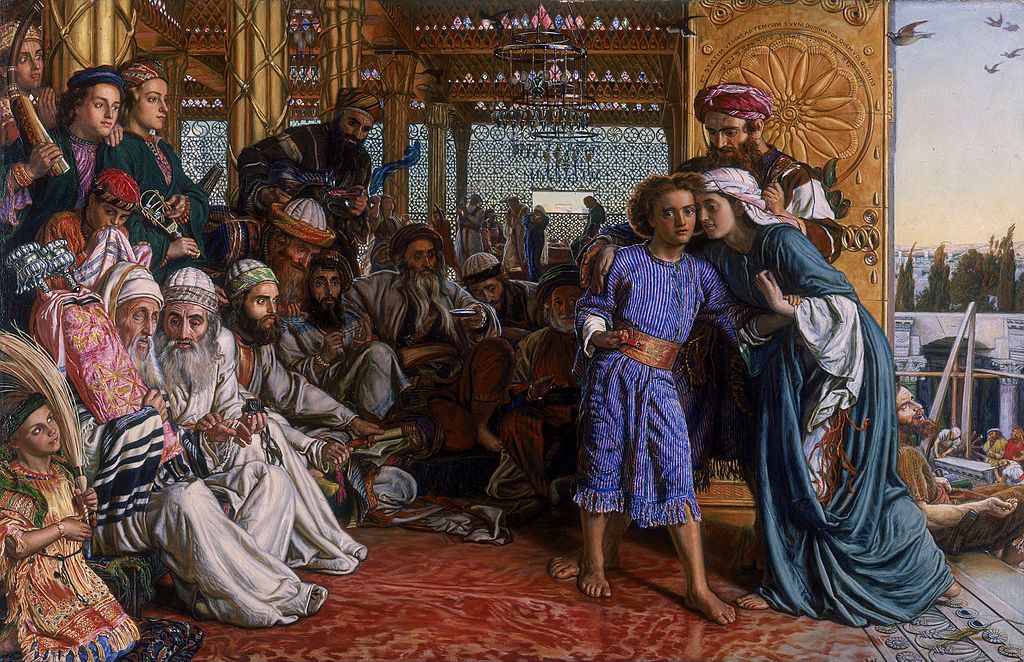
If Arabia seems a long way from Chivalric Britain, it didn’t to 19th century British authors and artists. The disordered England of Walter Scott’s Ivanhoe depends on the absence of Richard the Lionheart, who was off defending Christendom from the Saracens in the Third Crusade, leaving wicked King John to usurp the kingdom (and those loyal royalist Cornish were supposedly ransoming Richard with “bezants,” or so they said a century later). Bringing the Crusades home to village scale, Ivanhoe teams up with Robin Hood and a disguised King Richard against John’s crony, the wicked Sheriff of Nottingham, whom we know is wicked because he stayed home rather than fighting with the Crusaders.
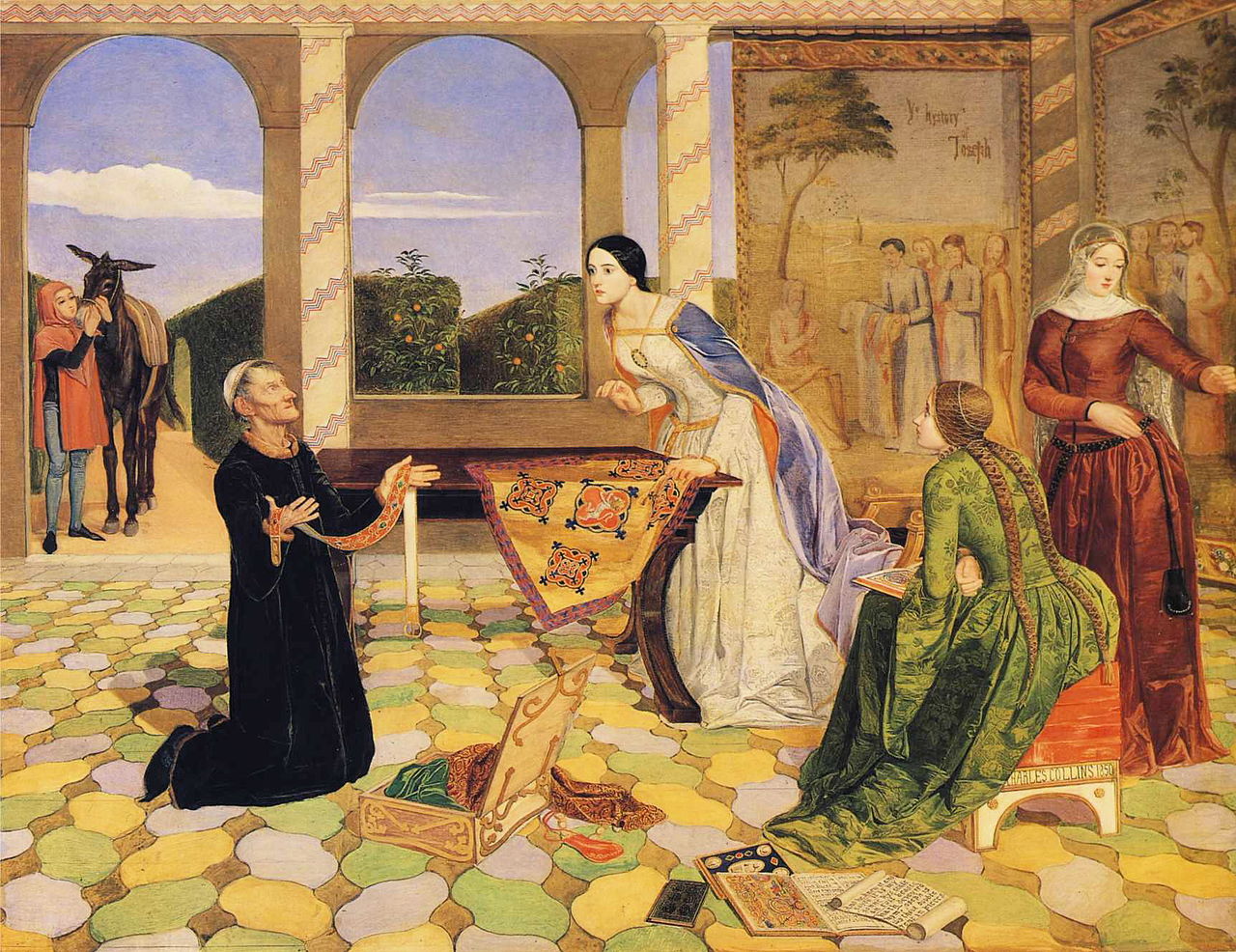
As is typical for Victorian medieval women, she’s making a tapestry. Or maybe embroidering. Women and cloth, weaving as female power. And the messenger disquiets her with a piece of decorated cloth, maybe something she made? Maybe Richard’s baldrick.
For another Anglo-Chivalric/middle Eastern mashup, Pre-Raphaelitist Dante Gabriel Rossetti liked to riff on the imperial, the patriotic, and the personal by painting himself in the guise of St. George, patron saint of England, together with his wife Elisabeth Siddell (or other paramours) as the Egyptian Princess Sabra, whom Richard Johnson had created to be St. George’s wife/reward in his Elizabethan-era retelling of the George-and-dragon myth, Seven Champions of Christendom (1596).

This Sabra doesn’t look much like Elizabeth Siddell, who is much more typically Pre-Raphaelite in the 1862 version, painted just before she overdosed on laudanum.
So there’s your Shining Armour Orient, right there – the East feminized, England her protector, etc. etc. There’s a 19th century Occidentalist gaze to hang beside the Orientalist one, too: the 1835 Arabic-language Boulaq recension of the Arabian Nights introduces post-Crusading Christians in the form of piratical Genoese villains, who capture and sell Muslims – which is a neat echo of that Orientalist cliche about Barbary Corsairs enslaving white women. (To get a sense of just how big a cliche this was and how much 19th century western Orientalist artists and viewing publics loved a bit of slave-erotica, check out this enormous and exhausting catalogue of pictures of odalisques and slave girls. NSFW in parts. None of them are actually pre-Raphaelite, though, as far as I can tell).
So what to do with all this? First, it’s interesting to note that the non-historical Islamic world of the 1001 Nights partners very neatly with the non-historical England of Arthurian romances: both sets of stories were being compiled at the same time and both regard their own times as tragically fallen compared with the earlier golden ages they choose to remember. During Malory’s life, Britain was being torn apart by the Wars of the Roses and he dreamed of a uniting Arthur, to heal its divisions. At the time of the Syrian Manuscript, the unifying Caliphate of Islam was a distant memory and Caliph Harun was an emblem of a lost purpose for the overall community of believers. In both story cycles the “present” landscape is a patchwork of petty kingdoms, robber knights and false courts… so it’s easy enough to imagine characters traveling from one to the other and maybe finding there the key to their own kingdom’s renaissance. Although maybe the least interesting approach is to throw in a lone lost wanderer, like Nasir in Robin of Sherwood. It might be better to invert the viewpoint and have your party be the foreign wanderers (fresh off the boat, to borrow Tekumel’s cliche) in the newly strange deserted forests of Albion – like in The 13th Warrior. If you want to mix in the 12th century Crusades but not from the usual jingoistic perspective, check out ibn Munqidh‘s memoir – and if you want to know how to get from Chretien de Troyes’s France to the Holy Land and back by way of Norman Sicily, there’s no better sourcebook that ibn Jubayr’s Travels. Personally I’d be tempted to mix up Antar with Arthur and start a picaresque comedy of errors.
Or do a points of light campaign across the known world, tied together by a quest for the Holy Grail or a lost Excalibur. Grail mythologies have long toyed with the idea of a Templar network linking East and West, so your Arthurian Grail Quest could go… well, at least as far east as Persia – maybe Alamut, with a stop-off at Ararat to tangle with antediluvian dinosaurs or djinn. If you go with an 8th century Charlemagne/Harun axis, you could run all the way out to Talas to fight or trade with T’ang Dynasty China and pick up some of their high tech printed paper, prophetic fortune-telling cards, and automata.
Another approach would be to run with the sheer variety of the stories – Arthurists tend to emphasize a unity to the corpus but it’s really very varied, with phantom islands and faerie kingdoms and strange visions in the mists. From the Red Knight of the North and his parody Camelot to the lost lands of Lyonesse, Ys, and St Brendan’s Isle, there’s plenty of room for different interpretations of Chivalry, politics, and even geography. Add in the meddling of Arabian Nights djinn and scheming witch-princesses, Mount Qaf with its underground mountain chains and ibn Majid‘s world map with a hollow pole and you can have your knights explore (or pop up from) tunnels through any inconvenient genre space in the known or mythic worlds. Give the players al Idrisi’s map of the world and let them deduce where the hex boundaries are. To really mix things up, locate either the Arthurian or Arabian world inside a djinni’s brass jar, so that one map can travel around the other, making impossible trouble and swallowing up whole towns along the way.
So far I’ve only been messing with the set dressing, rather than really getting my teeth into the thematic cores of the two story-cycles. I’ll be honest, I have a harder time imagining either Arthurian prophecy or the Arabian Nights’s humble fatalism as suitable material for building RPGs around. Man’s helplessness in the face of fate and/or God’s plan can make for good stories with surprising endings, but how do you make them interactive? What handles do they offer players to grasp, to make their own destinies?
And most of my ideas involve keeping the two setting flavours somewhat separate, or seeing how they mess each other up, rather than making a synthesis out of them. Still, with a slight reskin, they can definitely be made to play well together – imagine a story where a bold princess is imprisoned by her evil father, the masked vizier of a hidden sultan. Fate draws her toward a trusted old servant, who happens to be secretly raising the Once and Future King, her brother. And the only way she can communicate her peril is through two unprepossessing servants, one a dwarf, the other a pompous halfwit. It turns out both the Arthurian and Arabian Nights romances have plenty of stories for a family drama like that, requiring princess rescue and the destruction of the evildoer’s fortress.

You can probably even come up with some spurious scientific-sounding jibber jabber to justify a flying carpet race through the halls of the Sultan’s palace, to find and shatter that one vulnerable jar that contains his heart.

Bèton Breton
At Adam Thornton’s request, a quick review of some English and Breton brutalist structures.

I cannot find any credits for the architect or engineer who devised this, nor for the landscape designer who made it such an iconic ritual object. It’s currently regarded as “infrastructure porn.” Welp, give it a decade and people will start to celebrate it, or not.

Brest, in Brittany, was heavily bombed during WW2, so there’s a lot of postwar reconstruction. This church and the one following seem unusually interesting, to me at least. One recalls the Dutch “maritime modern” school of Amsterdam, the other has the reticulated look of a Berlage design.
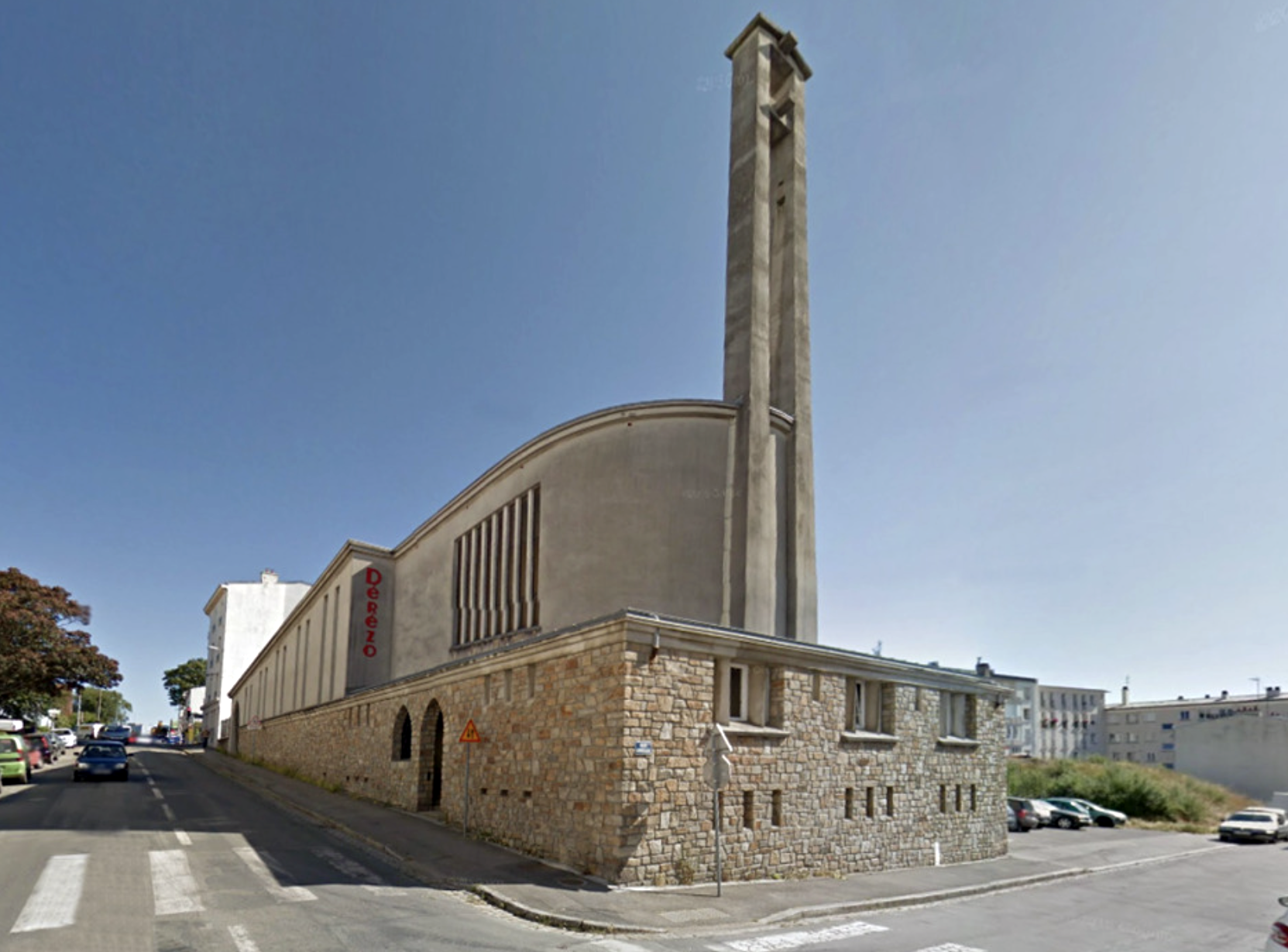

Brutalism for God continues into the 21st Century! The interior shots (click the links) make it look calm and meditative and less like a piece of electronics packaging.

I never even imagined that Ian Fleming might have named a villain after a postwar Hungarian-British architect, but apparently: “A discussion on a golf course about Ernő with Goldfinger’s cousin prompted Ian Fleming to name the James Bond adversary and villain Auric Goldfinger after Ernő—Fleming had been among the objectors to the pre-war demolition of the cottages in Hampstead that were removed to make way for Goldfinger’s house at 2 Willow Road. Goldfinger was known as a humourless man given to notorious rages. He sometimes fired his assistants if they were inappropriately jocular, and once forcibly ejected two prospective clients for imposing restrictions on his design… Goldfinger consulted his lawyers when Goldfinger was published in 1959, which prompted Fleming to threaten to rename the character ‘Goldprick’.”
But he didn’t. Everyone backed down, the film went ahead, and humourless Goldfinger forever afterward had to answer annoying, irrelevant questions.


You can also rent another bunker in the chain for holidays, if you feel like feeling like a Nazi artillery spotter for a week.
Pre-Raphaelite Arthur part 2
Last time I talked about some reasons why I think 19th century versions of Arthur have been ignored in RPGs. The core of my interest is really the Pre-Raphaelite Brotherhood – a loose collection of British artists and writers who shared a certain artistic sensibility in the middle of the 19th century, who promoted a distinctive view of Britain’s medieval history and who shared an enthusiasm for rich decoration; hand-worked, non-industrial art; and thin, red-haired women. They mostly knew each other, at least through the critic John Ruskin, who promoted their exhibitions, and William Morris, who did everything – fine and decorative arts, writing, organization, editing, promotion, sales… You could decorate your whole house with Morris’s work, from the furniture and wallpaper to the books on the shelf and painting in the study. So what happens if we actually look at them?
Well, there’s really a bunch of subjects all tied up together here:
– the differences between Tennyson’s 19th century Arthur stories and Malory’s 15th century ones;
– the visual storytelling of the Pre-Raphaelites and its influence over our “look and feel” for Arthurian type stories;
– the whole idea of the “medieval world” as a setting.
Taking the last part first, both the concepts of a medieval and a renaissance period were invented after the fact – first in the mid 16th century, to differentiate the then-improving present from the crappy past, and then in every time period since, to support narratives about the present. The idea of the medieval is based on a story that says Europe (and therefore “civilisation”) had been glorious under the Roman Empire but then it was plunged into darkness on September 4, 476 AD by the Goths, and there is stayed as a cesspool of disease and depravity for a thousand years, mired in a “middle age” between two golden ages. Roman civilisation was finally “reborn” (“re-naissance”) – in Italy, of course – and could first be recognized in the form of a new naturalistic skill in painting.
This story started as an art history theory and spread to other disciplines. The idea that visual arts can offer a barometer for cultural sophistication is central to the whole concept: if people can paint with perspective then, art critics reasoned, they must have maths, rationality, and improving public health. And to this day, hardly anyone really questions that equation. By the late 18th century Edward Gibbon, having noticed that early Christian art had turned Rome away from perspective and naturalism, blamed the spread of Christianity for screwing up the Roman Empire and depriving the world of working sewage systems.

The period of “rediscovering” ancient Roman glories and learning how crap Europe had been without them is obviously tied up with the 17th and 18th century “Enlightenment” movement (a term actually used by people at the time!), which can perhaps be summed up in the sentence; “now we’re no longer superstitious medieval idiots and we can finally think for ourselves, how shall we take charge of the world?” Maybe less obviously, this same period also saw European colonialism and early imperialism spread across the world. In the late 17th century, Europeans started thinking of themselves as superior not only to their medieval ancestors but also to other peoples – in Asia, Africa, and the Americas. The similarities in developing attitudes regarding the medieval past and the Orient are… striking, such that by 1800 I don’t know if either idea really makes sense without the other – Orientalism is the practice of viewing Asians as medieval and anti-medieval prejudice is a kind of Orientalism. In the second half of the 18th century European critics start calling Indian society “medieval” and “child-like” – an attitude that only strengthens right up through WW1.
But then in the 19th century, several things come together to give this Enlightenment confidence a bit of a jolt (outside France, at least) and swing the pendulum… somewhere else. First the French Revolution, which started by killing aristocrats and ended by crowning a commoner, made a lot of aristocratic rich Brits rather nervous. The rationalist French Republic had collapsed into a military dictatorship, just like the Roman Republic had (Napoleon even had a habit of dressing up as Julius Caesar, just in case you might have missed that historical echo). After Napoleon’s capture in 1815, “Romantic” movements started to question the Enlightenment’s confidence in engineering every aspect of the world and humanity – if it led to dictatorship, maybe it wasn’t so desirable? The best-known expression of this counter-movement is probably Mary Shelley’s Frankenstein; or, The Modern Prometheus, with its over-reaching scientist and dispossessed, sympathetic “monster” offering a pretty transparent critique of turn-of-the-19th-century society. In visual art there’s less imitating Greece and Rome, more striking dramatic poses and expressing (horny, restless, heroic) emotions.
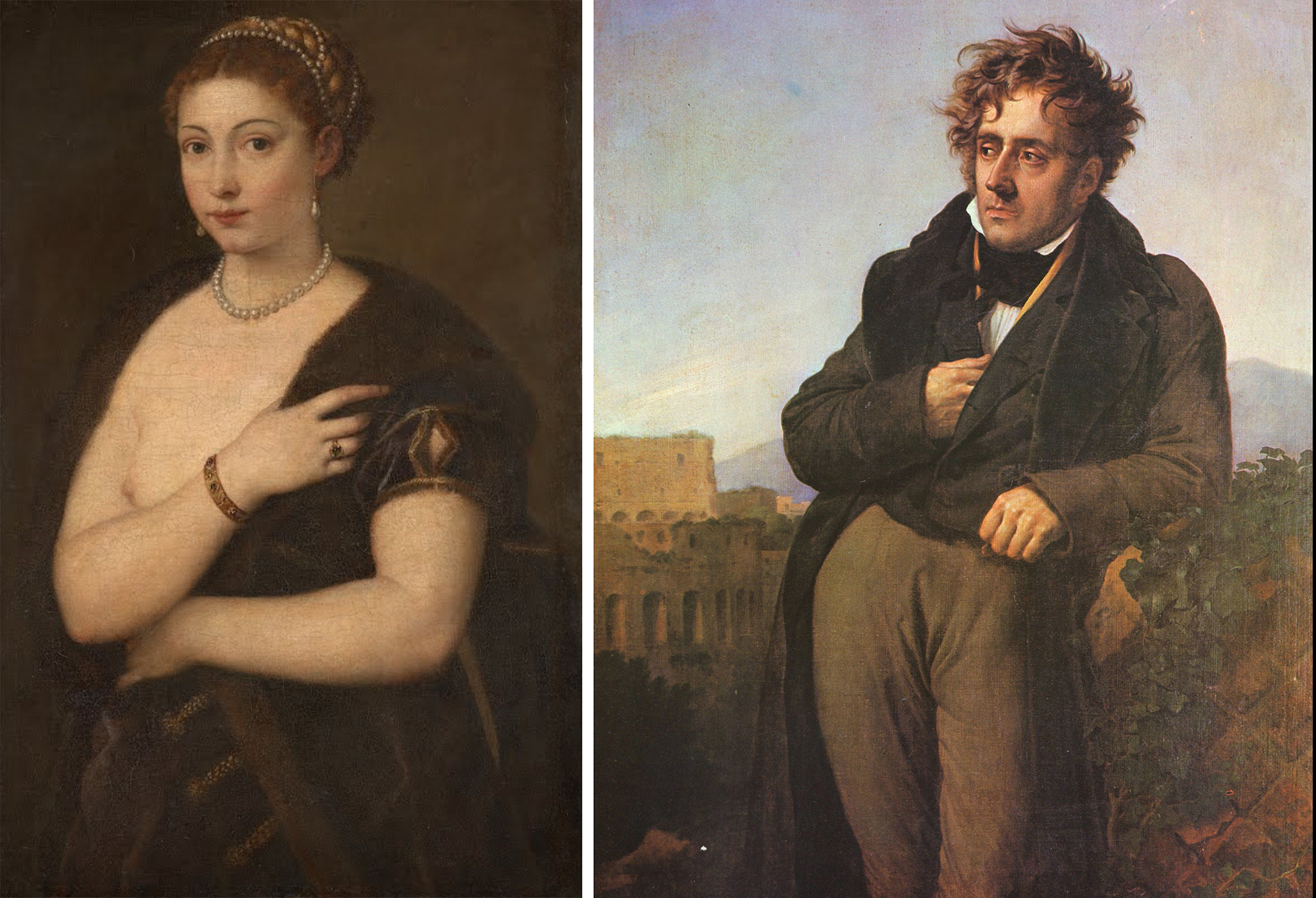
Right: Anne-Louis Girodet: Chateaubriand Meditating on the Ruins of Rome, 1808. Thoroughly Romantic. Note how his powerful meditations ruffle up his hair, giving him a windswept and interesting air. He’s thinking “even mighty Rome could not escape the inevitable dissolution of all worldly majesty.”
Second, there’s a rise in nationalist movements all over Europe. Nationalism is a sort of religion that claims the people of this territory are different from and better than those next door. This territory’s people must therefore rule themselves independently and define what makes them so awesome. That awesomeness almost always comes from the incalculable past, maybe the beginning of time itself, and is generally found in the soil, the blood, and the spirit of the people. It tends to suddenly burst out in revolutions, where you can finally see it waving free and shocking the formerly powerful but now degenerate imperialists who were holding it back.

Third, there’s a big Gothic Revival movement over much of Northern Europe and especially Britain after about 1850, which strangely rehabilitates the medieval, bringing it into the growing nationalist mythologies.

Late 19th century buildings in Germany, Canada, and England. Source.
What? Weren’t we just clawing free of our medieval constraints? Well,
(1) those primordial nationalist roots are eternal, not constrained by the changes of time, so it’s hard to be proud of your Nation in perpetuity while also being ashamed of it before a couple of hundred years ago, and
(2) I have a sneaking suspicion it is not accidental this rehabilitation happens at the same time that “scientific” racism becomes fashionable. During the 19th century, discourses of colonialism get more racialized (at least in Britain, France, and Germany), so that colonized people are seen not so much as “backward” but as “fundamentally inferior.” Scientific racism allowed for a decoupling of anti-medievalism from colonialism, i.e. it allowed you to be both Orientalist and enthusiastic about the non-Roman bits of your history at the same time. And
(3) rapid industrialization was irreversibly reconfiguring the landscape and society of Britain and the British Empire worldwide, in ways that made it significantly less amenable to Romantic celebration. It turns out “rationalizing” business into Capitalism doesn’t spontaneously create a sort of neo-Greco-Roman ideal world. So a bunch of British intellectuals and aesthetes started pining for a simpler time before the Neo-Roman imperial movement began… or maybe they were just sick of Enlightenment neoclassicism, or maybe they wanted to show that Britain had always been great, even through its supposed “dark ages” before it rediscovered Italian civilisation.
If this sounds anti-progressive, yeah it is, although its proponents would insist they just wanted to be smart about progress and not simply accept whatever changes happened to be happening. The Gothic Revival movement was also often semi-self-consciously fantastical: they tended to decorate garden follies or make new building types – like railway stations – look reassuringly medieval on the outside while doing nothing to disguise their Dark Satanic Mills on the inside. When Gothic Revivalist Pugin contrasted the “best” of the medieval world (very often heavily idealized) with the “worst” of the Enlightenment – juxtaposing e.g. medieval almshouses with enlightenment Panopticon prisons, he deliberately glossed over the better comparative cases – medieval punishments and enlightenment charity like he wasn’t even trying to win an intellectual argument.
As I mentioned last time, you draw your boundaries where you want, to yield the specific effect you prefer. The Pre-Raphaelites drew their boundary right at the cusp between the late medieval (early Renaissance) and the High Renaissance, just before the church lost its near monopoly on approved subject matter for paintings. They decided that British painting had been cruelly hijacked and made to serve Classicist Italian models ever since Sir Joshua Reynolds had started up the Royal Academy of Arts, because Joshua felt that everything could be improved by adding ancient Rome – he thought painting had returned from the dark ages under the brush of Raphael and that Rubens and Reynolds himself were Raphael’s successors.
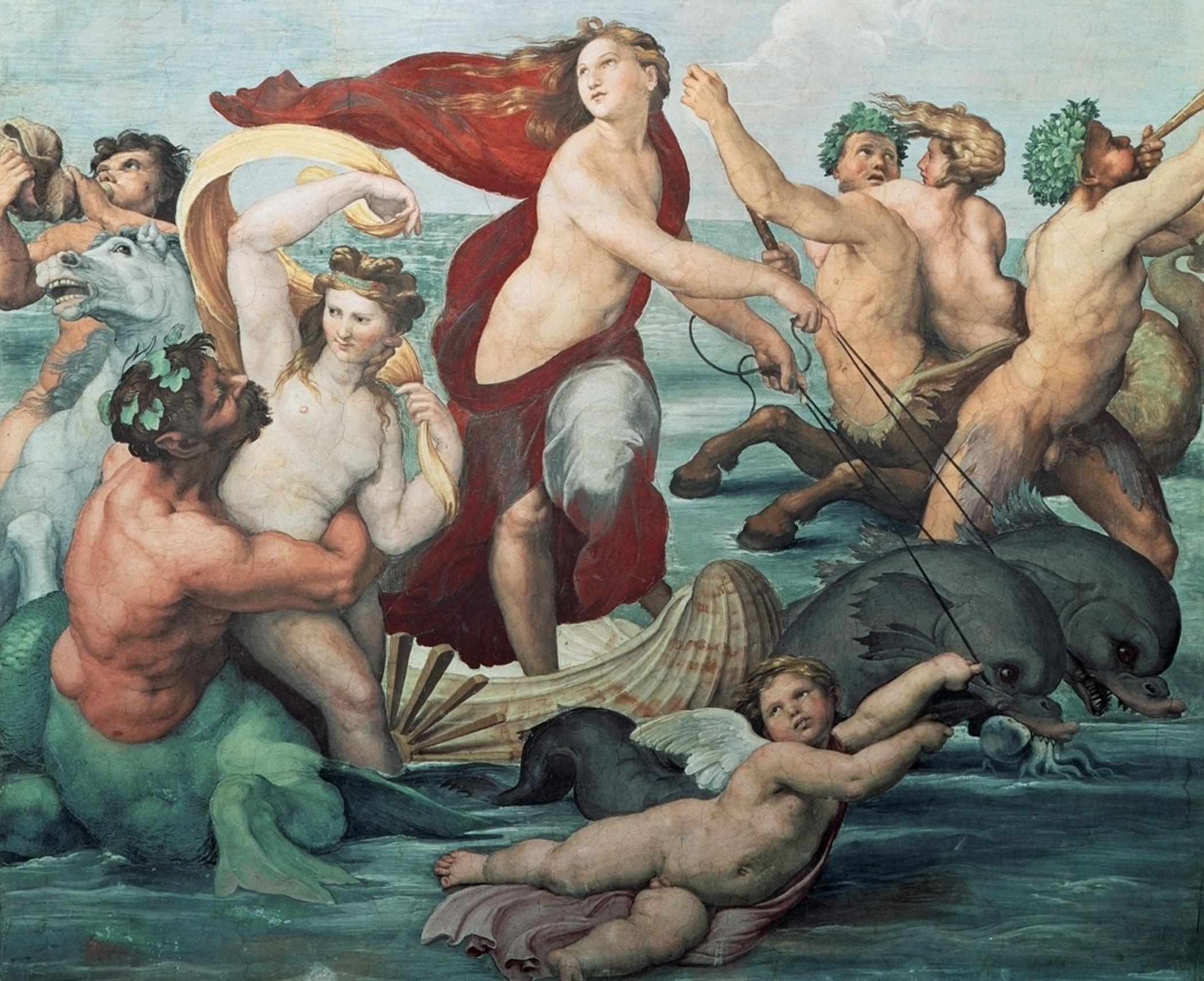
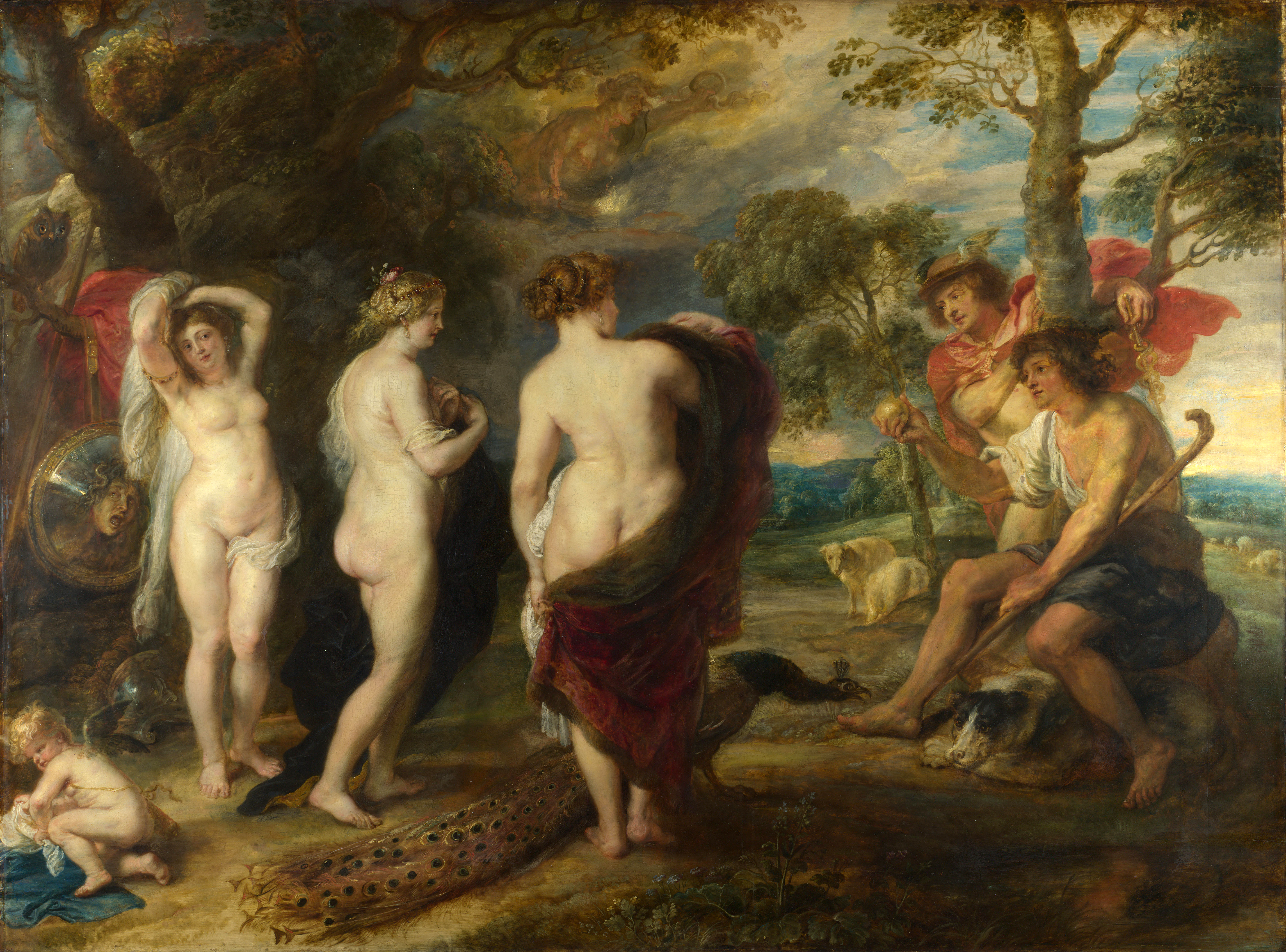

I dunno, personally I’m not totally convinced Reynolds was up to Raphael’s standard...
Sick of the Italian High Renaissance contraposto and chiaroscuro lighting that Raphael had championed, and sick of the slavish Classicism of the Royal Academy’s judges, who preferred eg. Jacques Louis David to the Pre-Raphaelites’ own Edward Burne-Jones, the Pre-Raphaelites formed a Brotherhood to celebrate the awkward poses, meticulous costume detail, and flat picture planes of the painting world that Raphael had ruined.

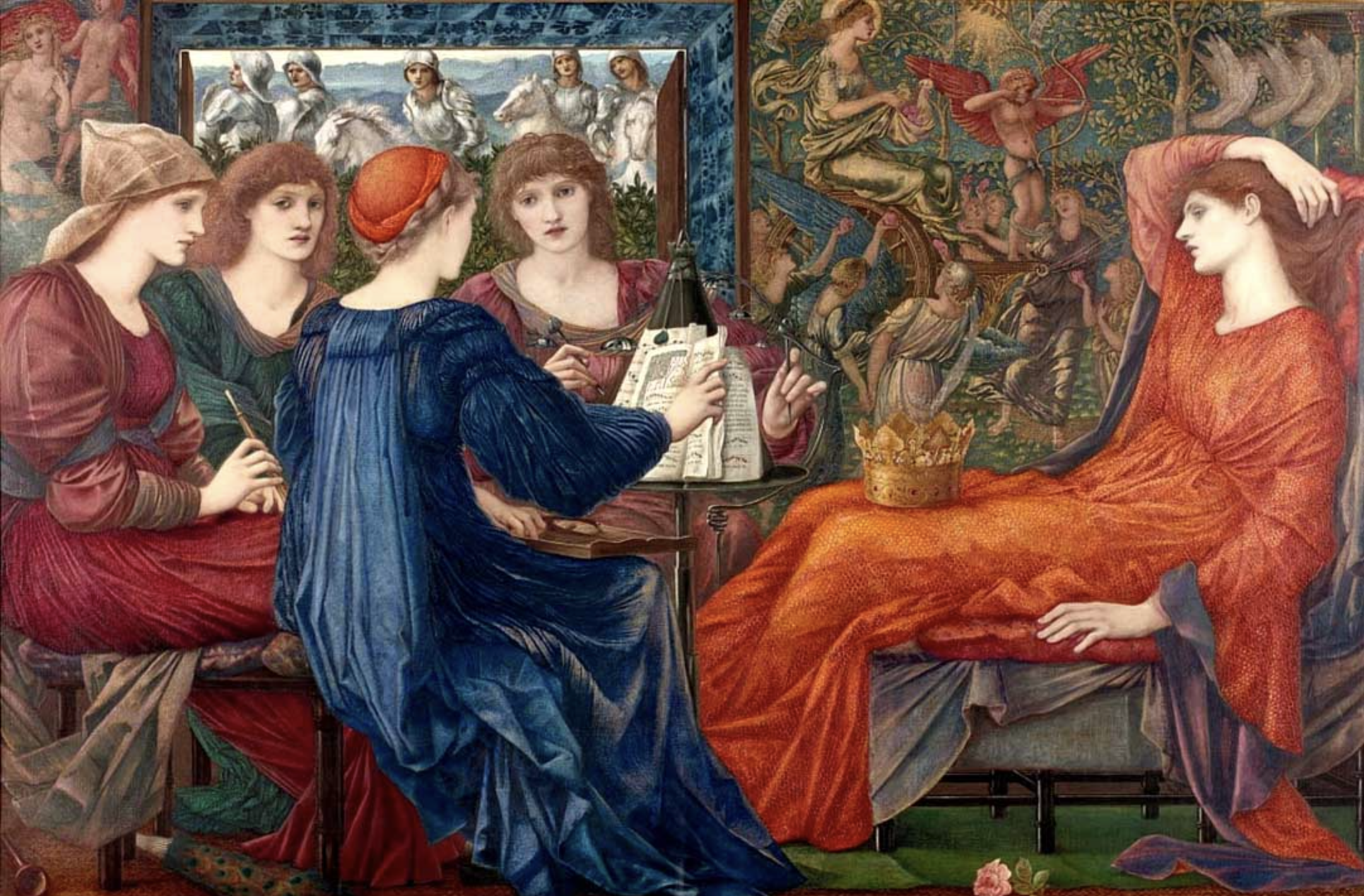
Their excitement about rediscovering a medieval sort of sensibility was not strictly historicist, though. They definitely said they wanted to strip away years of Enlightenment/Baroque nonsense to reveal a purer/more spiritual essence… but they didn’t want to excavate the past: instead they were interested in improving it – creating a more perfect, more authentic medievalism for their current moment. You can see the same impulse in Viollet-le-Duc’s restorations of e.g, the fortified medieval town of Carcassonne, where he harmonized the appearance of the conical roofs and added a drawbridge here and there, bringing the city, as he said, “to a complete state that may never have existed at any one time.”

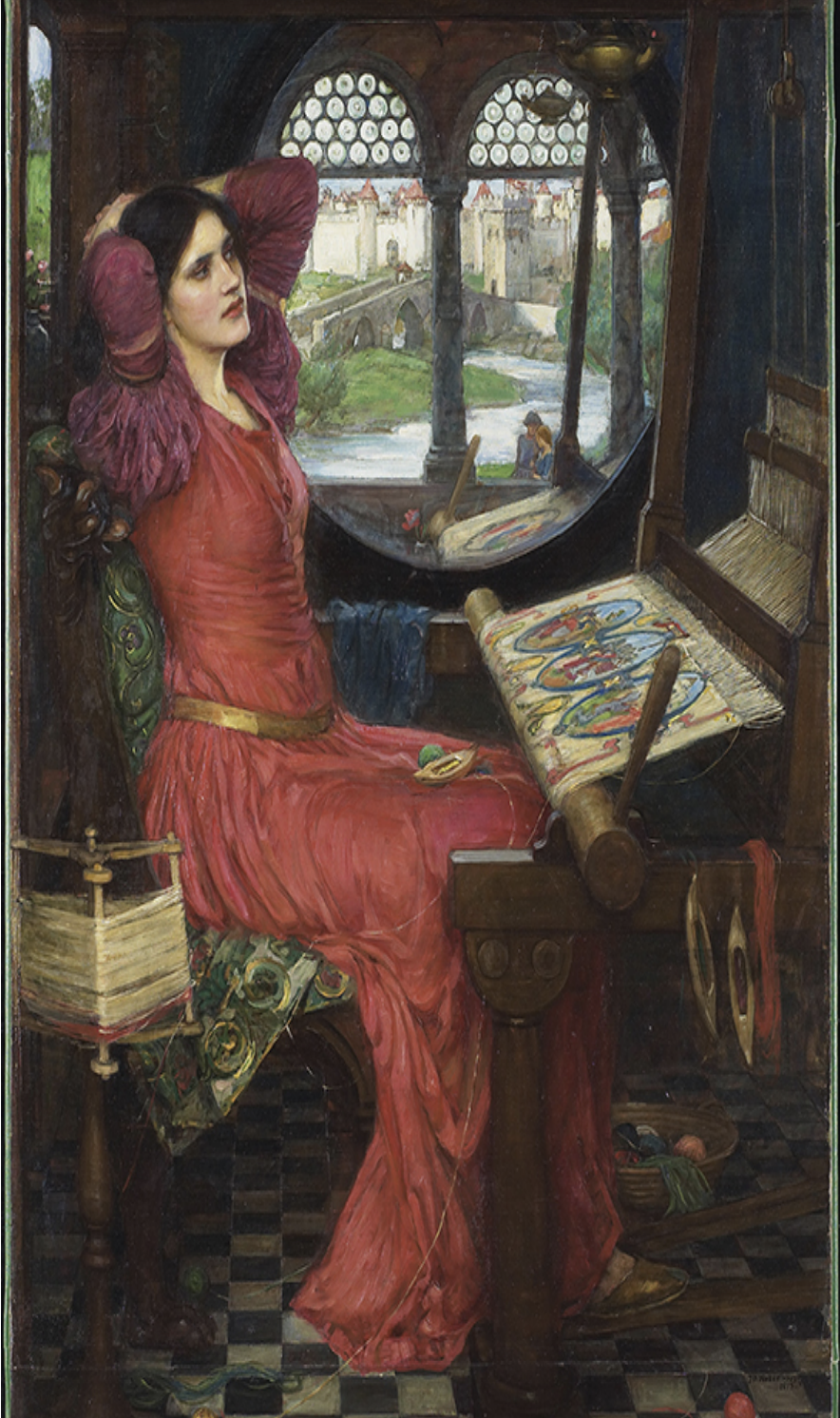
Pre-Raphaelite painter John Waterhouse puts Carcassonne in the mirror behind Elaine of Astolat (a.k.a. the Lady of Shalott), a minor character from Malory who plays a much larger role in Tennyson’s 19th century Idylls of the King. She is shown here tied up in her tapestry-wool, an apt metaphor since in Tennyson’s poem, merely by leaving her womanly position at the loom, the Lady dooms herself to death. BTW I’m pretty sure that’s William Morris’s loom, that Waterhouse’s model is posing beside.

The sheer number of Pre-Raphaelite paintings of the Lady of Shalott is daunting. Evidently, they found her to be Tennyson’s most compelling subject.
OK, so. Tennyson. When it comes to a more perfect medievalism, it’s pretty interesting that Tennyson chose Malory’s Arthurian myths rather than, say, Chaucer’s Canterbury Tales as his window into the period. Both are works of literature, so neither should really be trusted as guides to their originating societies but… Chaucer drew portraits of many of the social types of his times, he was interested in peasants and millers and landowning ladies, alongside the more conventional knights and squires. He wrote about their concerns regarding marriage and wealth and poverty and birth and death and farting. Malory’s world, on the other hand, only really consists of knights and ladies, knights and quests, knights and false robber-knights. Tennyson’s main contribution is to refocus Malory from the knights onto the ladies’ experiences, retelling the stories as dramas of women and presenting those women as products and victims of their station. When people talk about the miserable state of Victorian gender politics, chances are they have Tennyson lurking in the back of their minds.
So when Sir Lancelot-the-Heartthrob uses the “favour” of Elaine of Astolat to joust and gets injured, all to defend Guinevere’s reputation, what Tennyson writes about is Elaine falling in love with Lancelot while she tends his wounds, Lancelot ignoring her (for honour and because secretly he loves Guinevere), and Elaine dying of a broken heart. Note, even though this is Elaine’s story, her agency in it is restricted to loading herself into a boat and clutching an accusatory love letter to Lancelot, so that her dead body drifts down to Camelot and her story is finally heard posthumously, causing the court to weep.
…if you were writing an RPG about Chaucer, you would need massive sourcebooks about all the various walks of life and society. You’d want varied character classes and backgrounds etc. An RPG about Malory (other than Pendragon) might be best served as a limited-frame storygame, where the players take the two roles of Knight and Lady, and the quest objects and background are generated ad hoc. A game based on Tennyson’s Idylls of the King would probably be single-player storygame (the Lady), with the object of getting Arthur to understand anything about your life, with nothing but flowers to communicate your meaning.

Hey look, there’s another set of roundels like the ones she was weaving, only this time they’re quilted.
Gustav Dore (not a Pre-Raphaelite) also illustrated Tennyson’s Elaine, in a style that makes her look less tragic and more consumptive.
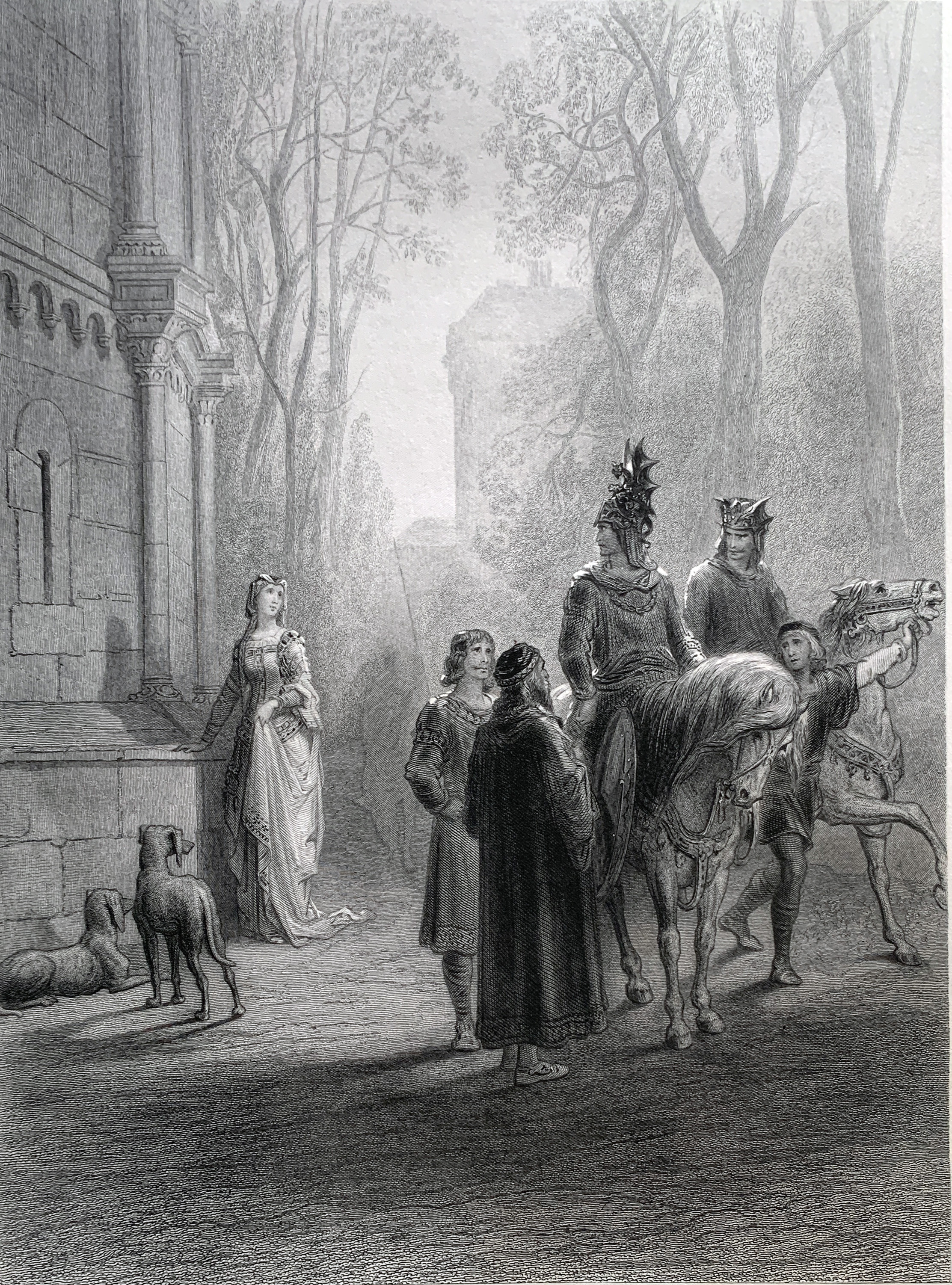

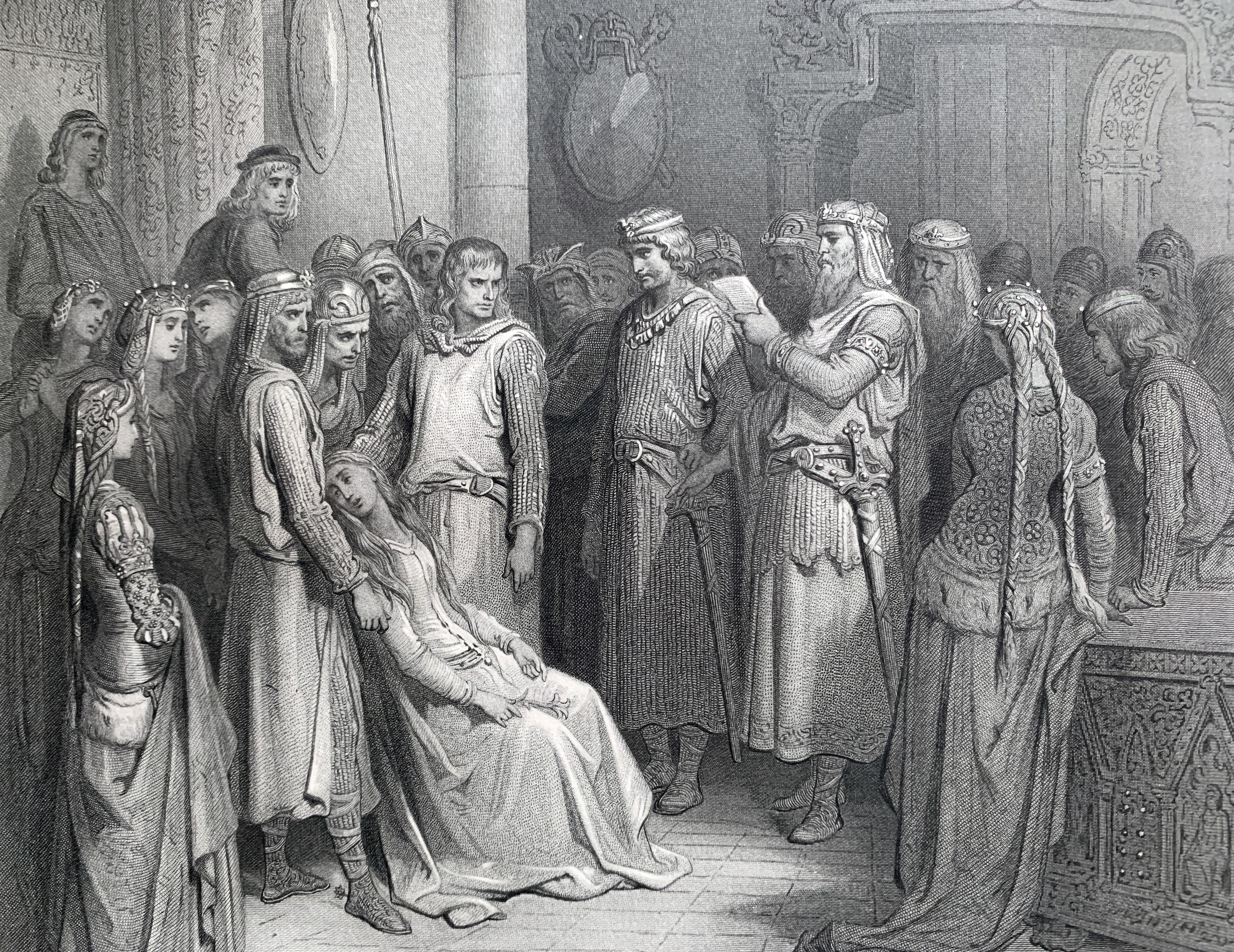
Aside: I think (and I expect I’m in the minority here) there’s a recognisable German-ness to the Dore illustrations. I add them here because I think the contrast with the Pre-Raphaelite depictions really points up how distinctive the Pre-Raphaelite vision is: the expressions and attitudes of the women, the attention given to their material culture, cloth, embroidery, jewelry, etc. and the equal attention given to “foreground” and “background” elements all suggest a larger world that extends beyond the canvas – far more, I think, than Tennyson’s poems demand.
Of course, if romantically-painted Victorian women aren’t swooning tragically, they’re vectors for sin and witchery… which I have to say, the Pre-Raphaelites really enjoyed. The villainous old gossip Vivien follows Merlin to a remote place across the sea and seduces then curses him, taking him away from Arthur’s side so that Arthur can enter his tragic final phase.

Morgan le Fay, Arthur’s witchy sister, when painted by Frederick Sandys embodies all sorts of exotic dangers, suggesting a much wider world than Malory knew:

Birmingham Museum’s label (as recorded on Wikipedia) notes that Morgan le Fay is shown “in front of a loom on which she has woven an enchanted robe, designed to consume the body of King Arthur by fire. Her appearance with her loose hair, abandoned gestures and draped leopard skin suggests a dangerous and bestial female sexuality. The green robe that Morgan is depicted wearing is actually a kimono” – so, still intimately involved with cloth and weaving, but this time weaving Arthur’s downfall!
There’s another aspect to this layer of Arthuriana, though, that I think is part of that unavoidable frame the 19th century hangs around our vision of the past. Note the Egyptianate figures on the wall behind her, the vaguely Indian-looking statuette, the magical devices on her gold dress. Also, check out the spear that wicked King Mark uses below to strike down Sir Tristram in Ford Madox Brown’s contemporary Arthurian painting, the death of Tristram/Tristan:

Where did King Mark of Cornwall get a Chinese (or Japanese?) spear? Is that an Indian dagger in his belt? What about the Turkish (or Persian) designs on the curtain behind him? There’s a clear Orientalist presence in these paintings – certainly around the villains (the heraldic Bezants that identify Mark as Cornish were supposedly gold from Byzantium paid to the Saracen for Richard I’s ransom, so they’re Oriental twice over, while still being Cornish…). But even the very unvillainous Lady of Shalott’s death-shroud in Waterhouse’s painting, above, suggests an Indian Chintz, the subject of London’s great 18th century Oriental fashion craze (which BTW started that neo-Gothic trading palace, Liberty’s of London – purveyor of William Morris fabric prints).

I think the intention of this Orientalism is probably atmospheric rather than ethnist or strictly imperialist – my sense is that the pre-Raphaelites’ perfected medieval world contained the riches of the Orient, that in our inadequate history only became visible to the British around the time of Elizabeth I. The moral lessons they sought to draw from Arthurian legends demanded setting in silks and jewels – like the ones from an ancient crown that Tennyson has Arthur distributing to his jousting champions.
As for that famously shiny armour, about 10 years after the Pre-Raphaelite painters made their mark on Arthur, a (sometimes) Pre-Raphaelite photographer added hers: Tennyson invited Julia Margaret Cameron to create another illustrated edition of his Idylls of the King in albumen prints.

Cameron used whatever props she could assemble for her photos. Here, Arthur and Lancelot are wearing Crimean War cavalry helmets, a glancing reference, perhaps, to Tennyson’s most famous poem. Or maybe there were just a lot of them lying about in the 1870s. Her Death of Arthur could be the prototype for the final departing boat shot in Boorman’s Excalibur.
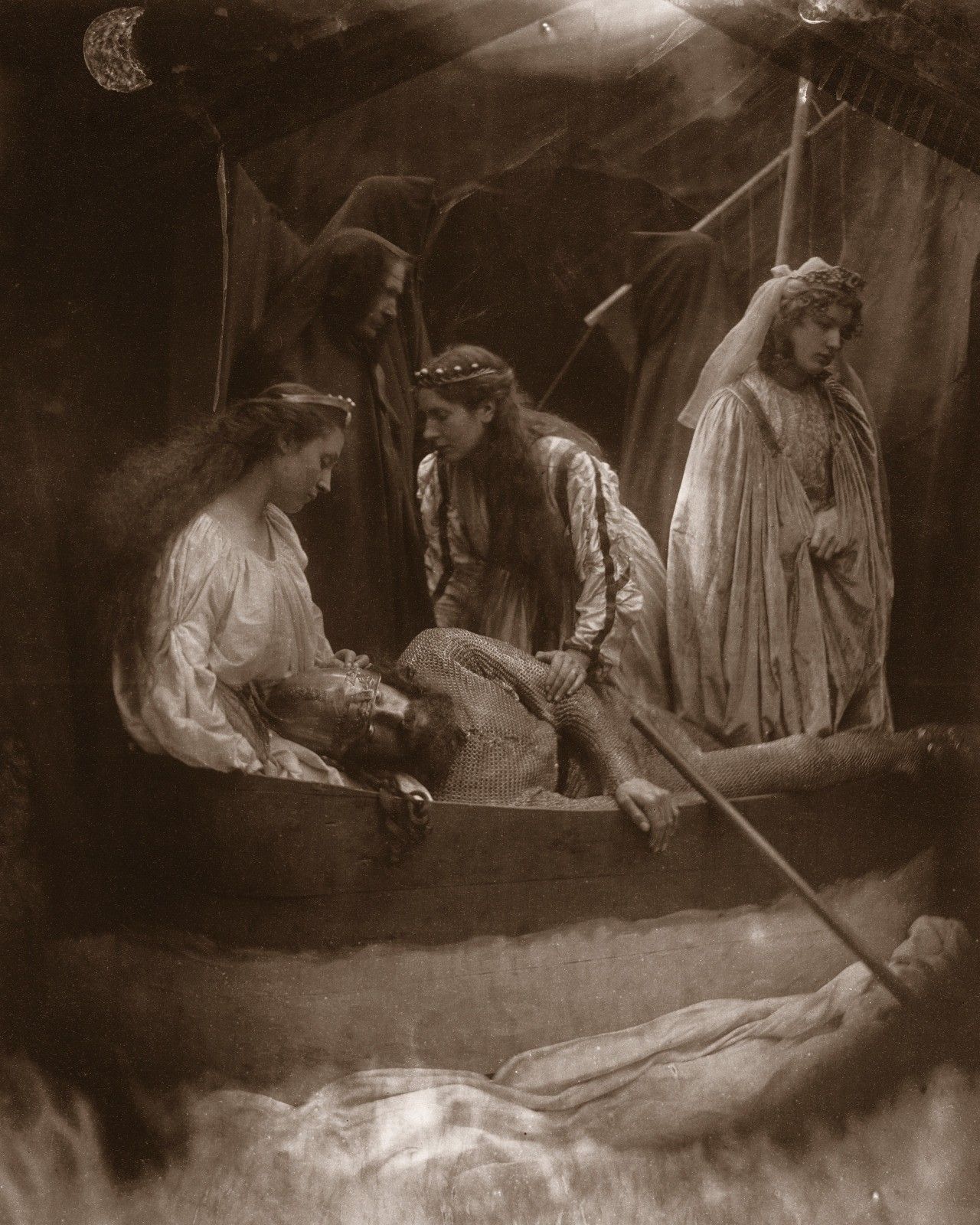

I don’t think Boorman’s Excalibur is really a neo-Pre-Raphaelite film, BTW – it’s pretty clearly Wagnerian – but it’s hard not to see those cavalry helms and the very shiny knights cantering through the window of Burne-Jones’s Laus Veneris,

reflected in Boorman’s ultra-high gloss, vaseline-glowing armour:
Final aside: I note that Liberty’s of London gets a credit at the end of Excalibur for “ethnic jewelry.” If that’s not a nod to the Pre-Raphaelites, I don’t know what is.

Pre-Raphaelite Arthur, part 1: Arabian Nights, Authenticity and the Arche
Over the summer I saw an exhibition of Pre-Raphaelite Arthurian artworks, which included a couple of tapestries, now owned by Jimmy Page of Led Zeppelin fame – he who took his copy of Lord of the Rings to the Glastonbury festival and (along with Moorcock) pretty much kicked off the liaison between metal and fantasy.

So I think there’s some interesting things to say about the content of Pre-Raphaelite Arthurianism but before I get there I have to clear my throat over the genealogy of Arthurian myth in popular entertainment and roleplaying circles – Arthur’s Appendix N, if you like – and why we seem to favour different ingredients of that genealogy at different times. So if you’re up for an extended musing on the history of Arthurian and British medieval representation, strap in.
While Gygax was percolating the ideas that would eventually become D&D, US popular entertainment was telling a particular set of stories about Merrie Oldee Englandeee, with Poul Anderson’s Three Hearts and Three Lions, Gilbertson’s Ivanhoe comics,

…and Disney’s 1950s anglo-historico-romance films: The Story of Robin Hood and his Merrie Men, The Sword and the Rose, and Rob Roy.
Together, those stories form a particular view of medieval Britain that draws heavily on the 1810s to 1830s works of that inveterate romantic nationalist Sir Walter Scott, the inventor of Ivanhoe, romanticizer of Rob Roy, and inspirer of, among others, the Pre-Raphaelites and Alfred, Lord Tennyson, who wrote a whole bunch of Arthurian epic poems for them to illustrate. To get a taste of Scott’s style and how his thought was shaped by Arthurian romances, you can look at his articles in the 1824 Encyclopedia Britannica, on Chivalry, Romance, and Drama:
“In every age and country valour is held in esteem, and the more rude the period and the place, the greater respect is paid to boldness of enterprise and success in battle. But it was peculiar to the institution of Chivalry, to blend military valour with the strongest passions which actuate the human mind, the feelings of devotion and those of love.”
As for the fair maidens who excited those manly passions, they had better be chaste and pure, because “wherever women have been considered as the early, willing, and accommodating slaves of the voluptuousness of the other sex, their character has become degraded… On the other hand, the men, easily and early sated with indulgences, which soon lose their poignancy when the senses only are interested, become first indifferent, then harsh and brutal to the unfortunate slaves of their pleasures. The sated lover,—and perhaps it is the most brutal part of humanity,—is soon converted into the capricious tyrant, like the successful seducer of the modern poet.”
So you can see how 50s Hollywood might have liked Scott. His rants against “the Romish clergy, who have in all ages possessed the wisdom of serpents” are a digression I guess I don’t need to go into now. On the other hand his frequent asides on “the love of our country and its liberties” played just as well in Joe McCarthy’s day as in George W. Bush’s.

So here’s a funny thing about encountering D&D’s version of the medieval in Britain in the 1980s: that heroic Scott/Tennyson strand was deeply out of favour. Especially in its Hollywood incarnation, with shiny armour and technicolor yeomen, it provoked an emetic reaction. I don’t know exactly why Britain went all in on the Dung Ages after WW2 (although I can hazard a few guesses, based on postwar austerity and disillusionment, changing class relations, the collapse of the Empire and Britain’s prestige, etc.). I also don’t know why Tolkien seems to have been exempt from it (C S Lewis’s Narnia was less exempt: wearing its Christian and Arthurian allegory on its sleeve, it was dismissed as children’s lit). But I do know that talk of shit-covered peasants wasn’t limited to Monty Python – Holy Grail satirized a popular discourse which had obviously gone too far, but which would continue to be repeated right through the 1990s.
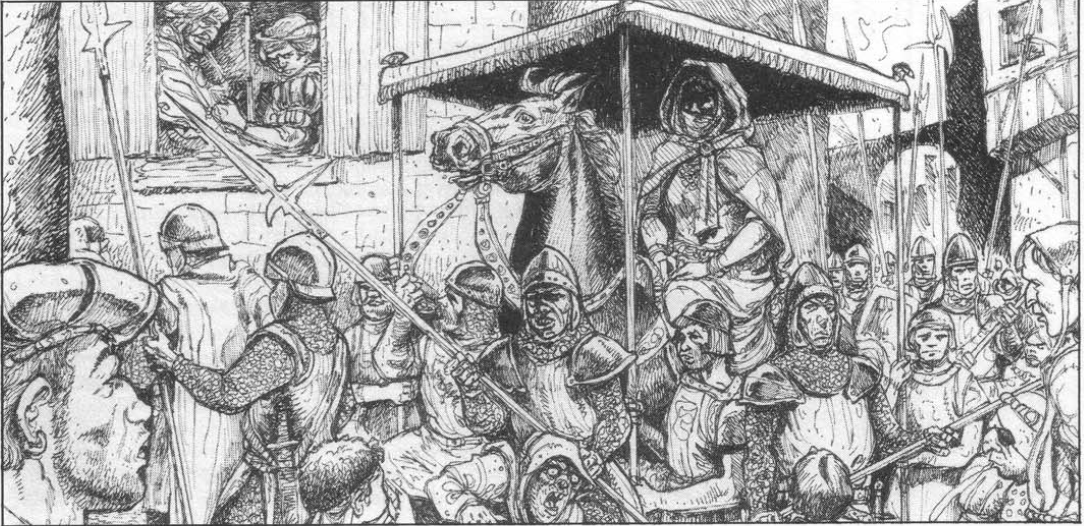
WFRP, obviously, encapsulates the RPG end of this mood about Britain’s past and character, but it doesn’t exhaust it: in the 70s and 80s my schooling emphasized the filth, disease, and short life expectancy of the medieval era as the bottom of a hole we had recently climbed out of. As for King Arthur, if there was any real historicity to him (and my primary school teacher was convinced there was), he was probably a Romano-British hill chieftain fighting off the Saxon invasion at the dawn of Britain’s Dark Ages – more a pitiable Alfred burning the cakes than any majestic flower of chivalry or guardian of England’s destiny.

(Aside: David Lowery’s recent Green Knight plays interestingly with Dung Ages tropes – the start of the film sees young Gawain sleeping off a hangover in a barn while the house across the muddy yard is burning. Arthur’s court is as threadbare and caveman-stark as any Trevor Nunn staging. But then Lord Generous’s tempting castle occupies a comfy Elizabethan early modernity – deviating from dung is where Gawain goes wrong, being a Son of the Soil after all)

So the Arthur I grew up with was part Monty Python, part dirt-poor resistance fighter – provided he was suitably dirty and down-at-heel. But if there was any whiff of the knight in shining armour cliche, that belonged to a discredited strand of romantic fantasies more akin to Mills&Boon bodice-rippers.
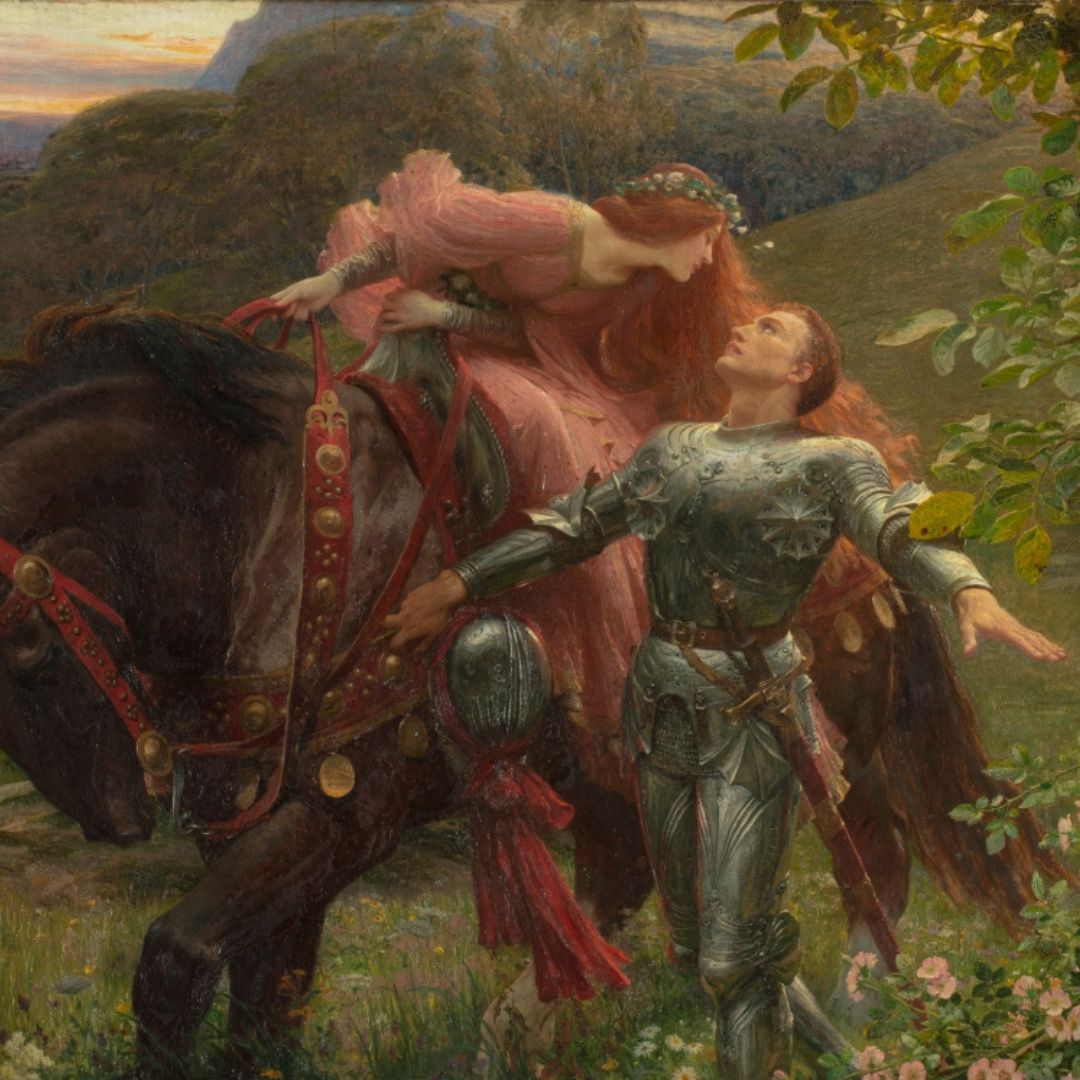
I knew there were stories behind that shiny romantic tradition (and there was Greg Stafford’s Pendragon, if you could get anyone to play it) and I knew there were images that went with those stories but… you had to kind of willfully ignore them, like in The City and The City. They were not serious or realistic or authentic (words actually used sincerely (by me!) in the 80s/90s regarding FRP rule systems).
As a result, my conception of what was properly medieval was resolutely unheroic and anti-Arthurian and I wouldn’t look seriously at the 19th century construction of Arthur for decades. It wasn’t right, it wasn’t “canonical,” it wasn’t worth bothering with: if there was any way for me to rediscover Arthur it would be by looking straight past the romantic knight tropes and past Malory’s high romantic 14th century vision (still too shiny) and trying to squint it out of Geoffrey of Monmouth and the Mabinogion.
Which was stupid of me, first because Geoffrey of Monmouth is the Dave Hargrave of the 12th century, a reliable guide only to his own inventions (at best), and second because whether I ignored it or not, the 19th century work remains instrumental in forming the frame we all look through when we look back at the romances of Malory and Chretien de Troyes. Because, let’s face it, the 19th century always sits in between whatever came before and our view of it.

So I was already thinking about ideas of authenticity and historicity when I started listening to a reading of the Arabian Nights – specifically the collection edited by Muhsin Mahdi, which claims to be “the definitive Arabic edition… the oldest surviving version of the tales and considered to be the most authentic.” And it’s an interesting comparative case.
First, the 14th century Syrian manuscript Mahdi’s collection is drawn from is not the only claimant to antiquity – its reputation rests partly on its similarity to other old manuscripts. The editor notes “no one knows exactly when a given story originated, and many circulated orally for centuries before being written down,” which makes the whole question of what’s definitive hard to even discuss. But this apparent weakness in supporting the definitive claim turns out to be a secret strength for the stories’ authentic claim: “in the process of telling and retelling, they were modified to reflect the general life and customs of the Arab society that adapted them” so that the 14th century manuscript shows “a distinctive synthesis that marks the cultural and artistic history of Islam.”
Well. Maybe. I don’t know how you would prove that and I’m wary of claims to read the soul of the past, whenever they show up. In any event, choosing to cut this synthesis off at the 14th century is an editorial power move: it sorts stories into real (14th century) Islamic culture and… not. Which is how connoisseurship always works – carving out a subject on which one can become an authority. It is intensely annoying for a collector that there should be a diverse oral tradition that they can never fully capture and master. Different collectors hold up competing “original editions,” and then publishers want to cut through the confusion, claim the high ground and put out a “proper, authoritative” version, and then inevitably someone out there literally collects 1001 stories and…
And it’s a matter of interpretation and selection because, as the translator notes, the Syrian manuscript only represents one tradition of Arabian Nights storytelling. Some time after the manuscript was made, a vibrant print culture in Egypt and Europe distributed a load of reprints and rewrites, adding tales (including, notably, The Seven Voyages of Sinbad) and generally destroying the idea of a single common core of stories. Much of this print culture happened in French, which is the first language of several early editions of these “Egyptian” stories. The editor’s decision to exclude all of these and his dismissal of Aladdin and Ali Baba as forgeries (since they were written in Paris in the 18th century, maybe by an Arabic-speaking Syrian Christian migrant, and entered the corpus initially in French translation) establishes a fence between the Collectible Authentic Object and a yawning, inclusive chaos. If you let Parisian Aladdin in, do you have to include Disney’s Aladdin movies? So the omission of Sinbad and Aladdin, perversely, guarantees the authenticity claim because why would you leave the best-known pieces out unless you had a good reason?
Muhsin Mahdi has his reasons. But it’s up to you, really, where you draw your boundaries.
With the tales of Arthur and his knights, and with their place in defining the image of a medieval world, it seems to me that insisting on consulting only authentically medieval sources doesn’t do away with the problems of what to include – ignoring Malory is silly, because he’s already done much of the work of reading old Welsh for you. The Malory and Chretien de Troyes collections are famous and long-standing but not sufficient: there’s also the whole Matter of Britain still hanging out there, only partly available to non-specialists and tailing off into Welsh and Breton myths. If on the other hand we treat Arthuriana as a living tradition and draw a wide, inclusive boundary like we would with the “Egyptian” Arabian Nights, we wind up enclosing so many contradictory creations that we lose all coherence – it becomes impossible to say what isn’t Arthurian. Which is a real problem for a medium of collaborative storytelling like RPGs, where the important thing is to generate a common understanding – some stable platform that allows you to judge which actions are genre-appropriate and what does and doesn’t fit – what constitutes a knight, a quest, and a dragon, and why those elements matter.
So let’s imagine for the sake of argument we’re after a more limited, authenticky sort of specifically British Arthur and we arbitrarily discount anything from the advent of Hollywood, since that tends to change everything to fit its own shape. Before we even get around to worrying about which side of the pale Scott, Tennyson and the Pre-Raphaelites fall on, we have to deal with Henry Tudor’s propaganda version from the late 15th century, composed just a few decades after Malory’s death. In this telling, Henry VII, as unifier of England after the Wars of the Roses, is the returned Once and Future King. He commissions a Round Table for his eldest son, Arthur (yes actually) to rule from.
Nothing Arthurian ever goes according to plan, of course, so Arthur dies in childhood, leaving his brother Henry VIII to resurrect that Round Table idea, by repainting a giant antique table he found, to present himself as King Arthur reborn.

In fact, if there was ever a real, historical person who looked and acted like a romantic, literary Arthurian knight, it’s the young Henry VIII. He loved to joust – he even set up perhaps the greatest of all tourneys to challenge the French king and knights in 1520, which makes it about the same length of time after Malory’s le Morte D’Arthur as the Lord of the Rings movies came after the book.

And he had several lovely sets of full jousting plate armour – bullet-proof and everything – made in his own Royal Armoury at Greenwich.

And he was just about the right level of deadly and doomed when it came to the women in his life, although maybe popular history hasn’t quite pieced together that jigsaw puzzle of misogyny disguised as veneration, yet. His only real flaws as an Arthurian archetype are that he got old and fat (more villainous King Mark than forever-fighting romantic lead) and that he was born too late: the 16th century isn’t quite the right period for a character whose primary chronicler died half a century before – if we still believe at all in a “right period” for Arthur.
All of the Tudors were schooled in propaganda, so it shouldn’t surprise us that during the reign of Elizabeth I, Arthur (or possibly his relative Prince Madoc) was deployed once again as the secret original conqueror of America. “The case could be made therefore that, as a descendant of Arthur and through Madoc, Elizabeth had rights to North America” – and the hated Spaniards were merely squatting on English soil.
Oddly enough, that’s not the Arthurian legend Hollywood chooses to remember. But I can’t say I blame them – the popular consensus though history has been, if you want an authentic Arthur, you have to create one yourself. Which brings us back to the Pre-Raphaelites (in the next instalment).
“O purblind race of miserable men,
How many among us at this very hour
Do forge a life-long trouble for ourselves,
By taking true for false, or false for true;
Here, thro’ the feeble twilight of this world
Groping, how many, until we pass and reach
That other, where we see as we are seen.”
Tennyson: Geraint & Enid
Sedulous Icosahedron
The dungeon walls are mortared stone, damp and mossy. The ceiling hangs heavy with calcerous drips, lost roots and fronds of lichen. In the centre of the chamber’s north wall there is a round, ragged indent in the stonework, with stones lying scattered on the floor. A single, glossily clean, roundish boulder bulges from the indent like a pustule. Peppered with thousands of gemstones of all colours and laced with thick veins of gold, it is a treasure-hunter’s dream. And colossal! It stretches almost from floor to ceiling, a geometric marvel of sharp, triangular facets.
Approaching, you see some writing is carved on each facet – the one facing directly into the room says “START ME UP.” On the surrounding facets you read “HOW DOES IT FEEL?”, “PLEASED TO MEET YOU” and “IT’S JUST YOU AND NO ONE ELSE.” A single number 1 is visible, half buried in the wall.
If the players leave the stone alone, well, they will have left the dungeon’s single biggest treasure behind.
If they hack away at the wall and free it, it rolls onto the ground and totters a little. Instead of coming to rest on one face, its rocking motion increases until it starts rolling.
It will pursue anyone who has touched it until it crushes them. Essentially, it’s like the giant rock at the beginning of Raiders of the Lost Ark, except it never, ever gives up until it is destroyed.
diameter: roughly 9′
HP: in the thousands
It rolls initially at walking speed (4mph). For every 10′ it rolls without changing direction, it can increase speed by 5mph, up to 70mph on clear, flat terrain. It always knows where its target is. If they cross a sea, it will roll across the bottom to get to them. It is immune to fire, cold, poison (obviously) and lava damage – although if it passes through a long lava field, it will emerge red hot. If it runs into an object like a door that stops it, then it backs up as far as it can and rams it again. If 10 rams don’t knock the obstacle down, it looks for another way around it.
If it has multiple targets, it pursues the nearest one. So it is theoretically possible to trap it like Buridan’s Ass.

Good things about Phoenix Point – the world-building
OK so I’ve been kinda down on Phoenix Point here, but I have kept playing it, and although that’s mostly because I have a serious addiction problem with XCOM, it’s also because PP has some good qualities and particularly some good world-building, and I think that’s something you people would dig.
First, let’s get the yawn/eyeroll-inducing parts out of the way – yes it’s a
– postapocalyptic survival game
– with Mad Max collapsed-world petty kings
– and a “Lovecraftian” story
– and big machine guns
– and a pandemic that turns out to be aliens (always aliens), some of which look like they’re wearing your grandma’s underwear on their heads:

and more guns than people, just like America.
BUT its writers have actually read some Lovecraft, so it has a whole thing about deep time, hominid and human evolution (including a lurking shame in humanity’s DNA), long cometary periods, Yuggoth, and mind-control technologies. It even quietly raises some questions (without resolving them) about why aliens can control human minds. Is there some… basic compatibility between them?
AND YET in spite of this high level of literacy compared with most “Lovecraftian” video games, it’s still really the same level of seriousness as Stranger Things. It expresses that through occasional moments of satirical humour –

or

and it’s not even above Rickrolling you – each Haven of survivors has a motto; one of them is “Never gonna give you up.”
The soul of the game, though, is its three NPC factions, which have very distinct characters. In many ways, playing PP is about choosing between these factions – you are told quite explicitly that your own organization’s idea for winning is Pyrrhic – it’ll lead to the death of most of mankind, and anybody else’s idea is likely to be better. And each faction has its own technologies, so the wise player charts a course between them, gathering tools and strategy ideas from each. But the factions are designed as rivals with incompatible philosophies and they periodically throw questions at you, to find out whether you share their world view, and the designers have some fun framing those questions to make it uncomfortable for the player to just tell the faction what they want to hear.
They’re also…. strangely familiar. OK look, you could interpret them as takes on any number of historical prototypes – say, Romans, Persians, and Greeks; or the 3 dominant tendencies of late Weimar Germany – Nationalists, Christian Democrats, and Socialists; but to my eye, they look unmistakably like 3 (unflattering) faces of contemporary America: Authoritarian Conservatives, Religious Cultists, and Techbro Utopians. And the art does a phenomenal job of painting those three ideas, through their architecture and equipment, and their statements and approaches to problems.
The authoritarians call themselves New Jericho and their leader, Tobias West, is initially described to you as a billionaire with an uncompromising vision, but he is slowly revealed to be somewhere around Hitler on the dictator scale. Their buildings all look like mixtures of factories and barracks – the Military-Industrial Complex laid bare:

and there’s a pervasive grottiness to life in their Havens – messy mess tables for mass meals, military barrack showers and unmade beds, because who has time for niceties when there’s a war on? They’re also the only faction with propaganda billboards everywhere:

and toilet rolls; toilet rolls feature prominently.

Their APC and aircraft look distinctly like part of a Vietnam war timeline and their guns are resolutely bullet-based. You just know they get off on “rolling coal” and go hunting aliens for sport in their spare time,


and their color palette is murky cold grey and camo green.
Which could be a look for the whole game, right? Mad Max havens, the militarized future – but then you meet the cultists – the Disciples of Anu, and they seem to be living in a completely different world:

one that’s learning to live with the virus, and embracing mutation and the strange new skills they’re developing. Their ruling class are mind-controlling priests, they fly zeppelins, which are partly alive and partly blinged out,

and all their biggest buildings are temples, full of statues. In fact, they’re suspiciously well-funded – almost as if their cult leaders had been preparing for an end-of-the-world event for years before it actually happened.

And, refreshingly, they’re not necessarily the enemy. Sure, they have bad days where they start shouting at you to cleanse the world of unbelievers, but then you calmly say no and then another leader comes in and apologizes and says that’s really not their teachings. They’re sort of Neo-Sumerian or cod-Mayan, but I suspect they’re most of all Tekumel-inspired. And they just might have the best solution to the whole alien-virus-invasion problem.
They also might be onto something with their Sumerian schtick, because it turns out human (or hominid) civilization has been around a lot longer than people think and you can go dig up some Antediluvian Tech from secret Indiana Jones sites and it’s got this kinda gold floaty thing going on that’s more similar to the Disciples than anyone else:


Finally, Synedrion are the Techbro Utopians and they have two big obsessions – on one hand, Ancient Greek gods and Athenian democracy, and on the other, Silicon Valley corporate parks and Apple/Dyson product design.

Their buildings are full of cantilevered overhangs (which are kind of a nightmare in a game that shows you slices through the terrain, floor-by-floor) and giant textured glass walls (which you can’t hide behind but also can’t accurately shoot through), and their half-green-spaced parking lots are full of charging stations and fountains and trees that play havoc with your jump jets. They’ve long since abandoned petrol and bullets for cold fusion and lasers, and you just know their uniform fibers are ethically-sourced – even if they’re also long-term toxic and a landfill menace for future generations. Their planes and ground vehicles were clearly designed by the same hairdryer guru:


and with similar goals in mind – they have the fastest speeds, highest costs, and smallest passenger capacities of any vehicles in the game, because that’s who their users are, right? High-flying executives, mostly working alone. If you need to carry more people, buy two of them. Duh.
And looking at the game’s arc through the eyes of these three factions, I find myself asking (as I did with XCOM2), “what will life be like in this world, after you solve the immediate crisis?” And I’m genuinely not sure which of the factions I would choose to go live with… the game does a pretty good job of setting you up for “maybe something can be saved out of each of them, but maybe none of them is right as it stands.”
Oh, right, but that Stranger Things limit on seriousness? So each faction has a color palette – militaristic grey for New Jericho, Apple white for Synedrion, and lush purple and gold for the Disciples of Anu (though they wear it with a certain restraint that makes it look cohesive at least, if not logical).
But you the player can customize your color palettes for each soldier, or you can check the “randomize” button, and I am so glad I did the latter. Because the palette they randomize from is fabulous.

It’s always like this. Here’s what the randomizer gave me for a stealth unit, comprising a Sniper, a Priest, and an Anu Berzerker.

And you know what? I love it. I would Berzerk too. And I can always find my soldiers against a feature-rich background.
ETA: I have now finished the game and have spoilery denouement thoughts about the outros (which someone has handily collected in a video). Ending spoilers follow:
…so remember the Hitler guy? Turns out he’s more of a Hitler/Stalin figure, obsessed with purity:

and uncompromising unity. His ending gets the strongest mismatch between image and text:

although I wonder if all US players would get that it’s mismatched – after all, it’s a mainstay of American militarist propaganda that “freedom isn’t free” – you have to have a bunch of people signing away their freedom in military contracts in order to “protect the rights of every individual.” Bush’s mantra was that Iraqis must die in war so Americans may live in peace.
The Utopian ending has you freeing the aliens from being mind-controlled by their evil overlord, which is a highly interesting deviation from the Lovecraftian norm and raises Chimera Squad questions about how humans are going to live in peace with independent, intelligent species that have totally different ecological requirements. But its imagery ducks all these questions and just shows you some Syd Mead/Dymaxion architectural renders that you’ve already seen:

The one that cracks me up is the lovin’ the alien Anu Cult ending,

because of the dude with a cowboy hat and tentacles. Like “yep partner, that’s how we be naow.” Considering changing the name of this blog to “bound by the chains of an imperfect biology.”
Architectural history for gamers 2b: mountains and misdirection
So last post we’d finally got to the throne room at Kandy and discovered that maybe the god-king actually isn’t who we need to talk to. He sits there, absolutely immobile, a mysterious silhouette on a throne at the end of the ritual garden, while various courtiers tell you what he wants and how you should be bowing and scraping. What gives?

It turns out the god-king is supposed to make everything work (everything – the sun rising, the tides going in and out) just by being. Or by his Divine Will, if you want a kinda-Christian gloss on it. And so it’s vitally important for him to never lift a finger, because that would look like taking action, which is not what he’s supposed to do.
Typical PCs in this situation look around the room to see who’s really in charge – some back door or chink in the armor that can let them break into the system and make off with the loot. And Dutch East India Company officials are absolutely typical PCs. This whole throne room setup is not useful to them – you came on a pilgrimage to see a god on Earth and you got this close to the mystery, but the final veil cannot be pierced? Try telling that to the Company directors. Therefore it must be false.
And it turns out the throne room landscape is kind of a misdirection – the people who really have power are the various groups of Buddhist and Hindu priests who speak for the king and maintain the religious traditions on which the king’s power depends. The king might actually be powerless, or might be a player among players, or might be secretly running the show in spite of his immobility, but the priests can do things. A very similar situation existed in Bali during the same period, BTW – there, the real holders of power were the Buddhist priests who (can you guess?) …controlled the flow of water down the mountain.


And they need an enormous amount of water to operate – you have to flood them to germinate the rice, and then dry them out for the growing/ripening season

So how can the king of Kandy balance the power of the different priestly sects? This is where James Duncan’s book on the subject really comes alive – he gets into the court politics and the competing discourses on which court power depends, and the arena in which the power struggles play out, and in the end it’s all about landscape design.
See, everyone has a stake in the king being accepted as divine – all the different priestly groups want a stable kingdom (with themselves at the top, naturally), and that means a king that agrees with the story they’re telling in their temples. Water is life and it is right and proper that the lake (or reservoir, actually) should be next to the palace – that wave-swell wall is a reminder that “the crown adorns the kingdom, as waves adorn the sea.” But past that, everyone wants different things. The Buddhists want Kandy tobe more like the ancient Empire of Ashoka, when the water was kept for the welfare of all, and everyone came to the Buddhist temples for education. So their ideal king would open up the lake and the temples for public access and would teach the kids Buddhist scripture, and incidentally keeps the Hindus down as second-class citizens. The Hindus, on the other hand, want the kingdom to be like other Hindu kingdoms on mainland India, with access to water and temples reserved for the privileged classes, the water being nicely channeled into walled parks and gardens, the better to echo the park-like top of Mt. Meru. In their view, the lake, temples and king should all be a bit distant from the common people, tucked behind the palace walls.

Now, a canny king would play these interests off against each other, alternately favoring one faction or another, or managing to please everyone a little bit with signs that could be read favorably by any group. So he walls off part of the lake beside the palace, and makes a garden for the Hindus to enjoy, but the other shore of the lake is open access to the Buddhist commoners. Or he sequesters a shrine behind a palace canal but puts a big Buddha statue on the hill above it, or he makes rich garden apartments for the Hindu aristocrats but puts them some miles outside the center of the city, so that the aristocrats feel guilty about not staying there. And the result is an ambiguous landscape full of contradictory signs, where making a change anywhere could lead to a shift in the balance and re-reading of the signs everywhere.

The South Indian Mayamatam Shastra (a sort of architectural manual that tells you how to construct everything from a garden to a kingdom) says “if the measurements of the temple are in every way perfect, there will be perfection in the universe as well.” Which is a great way to keep all your religious advisors haggling about temple measurements, while you get on with ruling and raising taxes and waging war and peace. On the other hand, “if the king swerve ever so little from righteousness, the planets themselves will desert their orbits… rainfall will diminish, all life on Earth will cease,” which is a great way to keep your king in line.
The last king of Kandy was not particularly canny. He came up with a sneaky plan to imprison the Hindu aristocrats in a new, highly desirable set of mansions, but in selling them the idea, he also wound up walling off the most important Buddhist shrine – so his scheme of trapping the Hindus in a gilded prison just looked to the Buddhists like giving their rivals a load of gold, stolen from themselves. He demanded that Buddhist peasants do the building work and took Buddhist temple lands away to expand the lake… with the intention of rebuilding things to restore the balance later. The whole plan might possibly have worked out in the Buddhists’ favor if it had been completed, but… the Buddhists understandably saw the raw ditches being dug and the disorder in the city and a wall of earth going up around their Shrine of the Buddha’s Tooth, and… they complained to the English (who had replaced the Dutch on the coast), that this bad Tamil king was cutting down their sacred trees and creating “great mountains of earth… a place where dogs and foxes defecate at night.” Worst of all, he had built a giant monstrosity of an octagonal tower for viewing elephant races or some other such Hindu-inflected nonsense:

The very order of the world was under threat. Perhaps the English could step in and mediate, restore order, and put the king in his place?
The English, of course, didn’t care about any of that. They wanted cheap and reliable cinnamon delivered to the docks down in the coastal city of Colombo, and to spend as little time in Kandy, where the cinnamon grows, as possible. So they brought in troops and put down the king, and then put down the Buddhist elites, and set up a cinnamon extraction factory, and then chopped down the bodhi trees to make room for a tea plantation, and nobody got their lake or their mansions. They could have their Temple of the Tooth, though… once its keepers had lost their right to landscape the kingdom.

So how do you use all this in games? The first thing is, if landscape communicates, then it can also lie – or at least have multiple interpretations. Potemkin villages, carefully-framed views that have wanton destruction just outside the picture, presentations that conceal the true nature of things – Lewis Mumford said the weakest regimes tend to have the most solid-looking buildings. The second thing is, landscape is no more static than anything else – it may be expensive to dig lakes or flatten hills but landscapes also change by having different people living in them, or by being imagined differently. Whom does it serve (and whom does it flatter), when you put up or take down a wall, bridge, or dam? Access to water and farmland and streets and markets can raise some communities up and push others down. Power over the people generally involves some power for those people – and nothing makes people feel ignored and aggrieved like an imposition thrown up on their land. Forts and churches want to be able to see each other, to send signals and know that all’s well between them – what happens when you put an obstruction in the way?
To take an example from fiction, one of my favourite moments in the recent Westworld TV series is where we discover the Great Designer has been designing a whole new corner of the kingdom, with a giant bucket scoop excavator hidden over the ridge of his ersatz Western wilderness park. It’s a literal case of politics via landscape – he’s taking back control of his creation from his creations.

It’s an old joke that killing the dragon and looting its hoard will tank the local economy by flooding it with gold – but what about the land developers that were being held at bay by the prospect of being barbecued? Or the cult that can now “reclaim” their holy mountain? Or the cult that has lost their nightly firework display, that proved God was still on their side? The pilgrim routes that are disrupted, the royal roads that can now cut across the goblins’ swamp? Which provinces and ethnic groups will profit, which will be pushed up into those suddenly-open mountain pastures, forced to dig bits of dragon-glass out of them so they don’t lacerate or mutate their sheep, while the Emperor’s retired Elite Guards swipe all the fertile, long-fallow farmland? If you knock down the black monolith on Druid Mesa, how will the aliens know where to park on the next planetary alignment?
Of course, the state of politics can be expressed in a hundred ways. But the power of landscape is, it’s always there. And if it changes, you immediately know about it – when something is rotten in the state, it leaves marks on the countryside. And vice versa.
…I guess I’m just repeating what Lorenzetti said in the 14th century with his murals, the Allegory of Good and Bad Government, for the Palazzo Pubblico, Siena.


 Scrap Princess
- BEAST PEOPLE NAMES FOR BEAST PEOPLE
- Six Secret Books
- NooFutura available for purchase
- Leucrotta
- Weapon Breakage In Darksun
- Kickstarter Cognition Snare, 8th part of the Hexahedron of the Monks of Flame
- 6th Part Of Kick Starter Cognition Snare, The Hexahedron of the Flame Monks
- Kickstarter Cognition Snare: Hexahedron of the Monks of Flame : The Fouth Part
- Kickstarter Cognition Snare: Hexahedron of the Monks of Flame : The Second Part
- Demon Bone Sarcophagus Kickstarter Is Awrithe!
Reading Appendix N
- Two of my favorite practical mechanics in Delta Green
- A wild hair
- Longest campaigns I’ve played from 2008-2022, and other data neepery
- Going full-depth: collecting complete game lines
- My 2024 RPG collecting goal: All of Ars Magica 5th Edition
- DCC dice, inking, and pencils
- Sailing out of the painting doldrums with Blood Bowl
- New year, new look
- My Black Furnace #dungeon23 project is done!
- Godsbarrow apocalypse narrowly averted
Roles, rules and rolls
- Night's Dark Terror 15: Journey's End in Rifllian
- Night's Dark Terror 14: Funny Things Happen on the Way to the Horse Market
- New Dungeon Just Dropped! (Ancient School)
- Night's Dark Terror 13: Xitaqa 4, Curse You Golthar!
- Night's Dark Terror 12: Xitaqa 3, Up the Tower
- Night's Dark Terror 11: Xitaqa 2, Tower Base
- Night's Dark Terror 10: Xitaqa 1, Round the Houses
- Night's Dark Terror 9: Following the Clues
- Night's Dark Terror 8: Raid on the Goblin Fort
- Night's Dark Terror 7: Hexcrawling South of the River
Akratic
- It’s Tolkien Reading Day
- Darkmaster plans for 2024
- James M. Ward, RIP
- OSRIC Player's Guide
- Against the Witch-King: Chapter 1
- Against the Court of Urdor Campaign – Part 2
- My RPG Foci: Fantasy and Eldritch Horror
- Will Gygax’s Castle Greyhawk finally be published?
- Against the Court of Urdor Campaign – Part 1
- I Survived Helm's Deep
Lich house
- LOTFP Review: The Curious Conundrum of the Conflagrated Condottiero
- Catching Up with the Pillories (York 1630 Campaign)
- ACKS 2 Kickstarter - Last 24 Hours
- LOTFP Review: Winnie the Shit
- LOTFP Review: Galileo 2: Judgment Day
- LOTFP Review: Black Chamber
- Game Reports - ACKS and LOTFP
- The Strigoi - Vampire Alternative for LOTFP
- LOTFP Review: A Gift for All Norway
- Game Reports - York 1630 and ACKS Greyhawk
 Richard's Dystopian Pokeverse

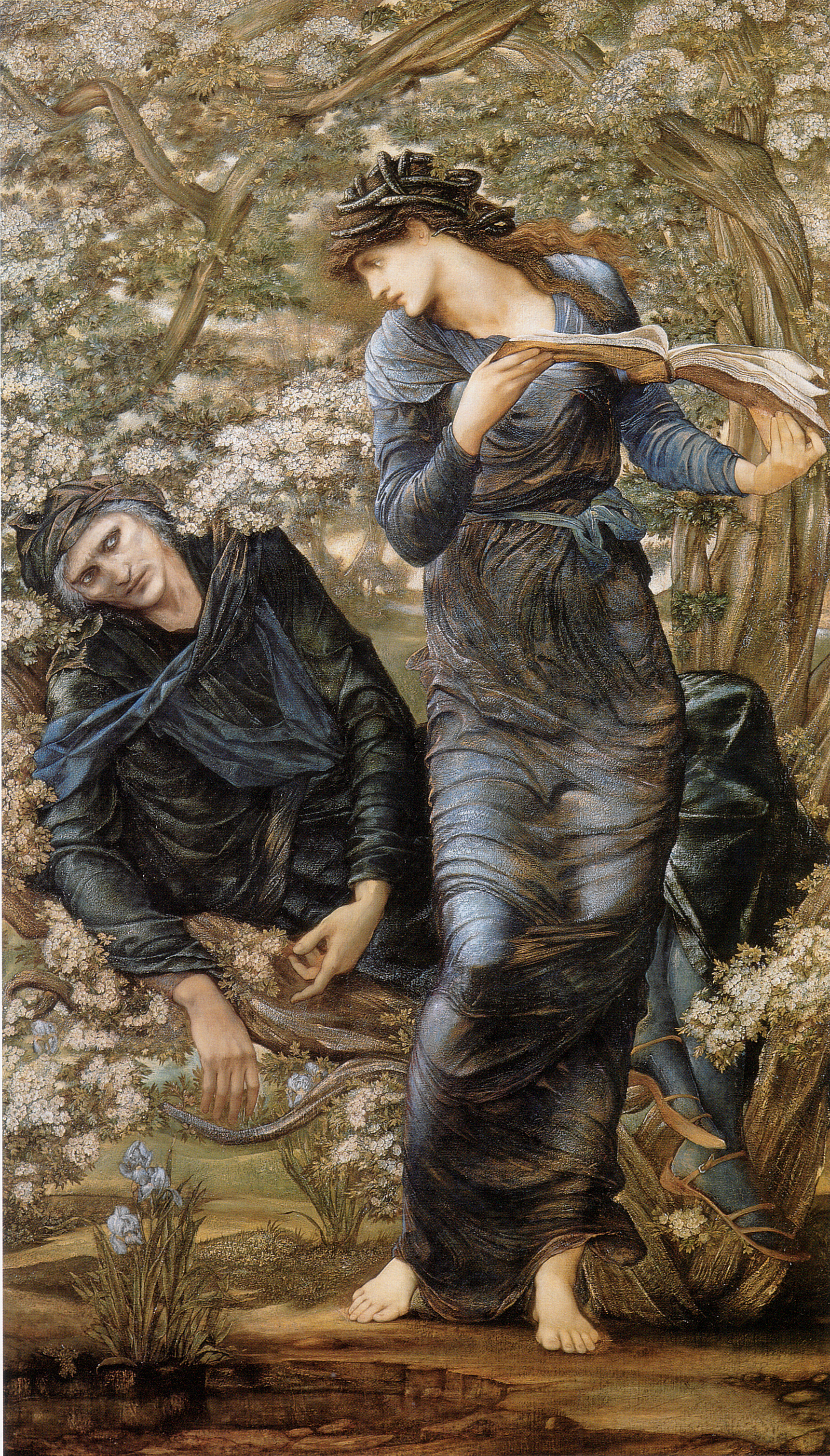
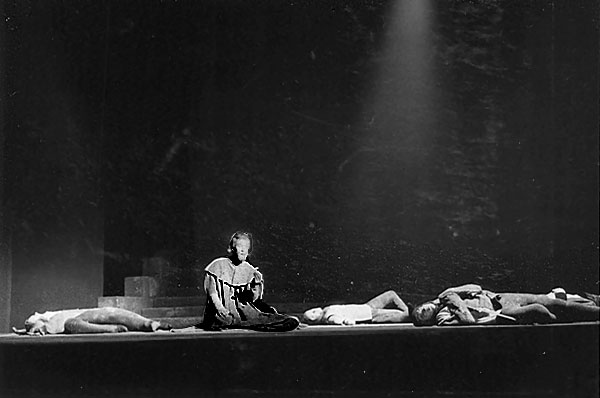
:format(webp)/cdn.vox-cdn.com/uploads/chorus_image/image/69649791/GK_05999_R.0.jpg)